Thamel, Kathmandu, Nepal
Kanchenjunga: The World's Third Highest Mountain – Complete Travel & Trekking Guide (2026)
There is a mountain in the far eastern corner of Nepal that most trekkers never reach — and that is precisely why you should go. Kanchenjunga, the world's third-highest peak at 8,586 metres, sits on the border of Nepal and India's Sikkim state, guarding some of the most untouched Himalayan terrain on earth. Unlike Everest or Annapurna, Kanchenjunga does not appear on postcards at every Thamel shop. There are no wifi-equipped espresso cafés at 4,000 metres. What you get instead is raw, genuine Himalayan adventure: forested ridgelines draped in red pandas, rhododendron forests that burn crimson in spring, Limbu and Rai villages where life moves at the pace of the mountains, and an absolutely staggering base camp view that rivals anything Nepal has to offer.
This Kanchenjunga travel guide for 2026 covers everything you need — trekking routes, updated permit rules, realistic cost breakdowns, weather windows, itineraries, and honest advice from the trail. Whether you are a seasoned high-altitude trekker considering the full circuit or a first-timer curious about the shorter North Base Camp route, this guide gives you the information to plan your trip with confidence.
Planning your Kanchenjunga trek? Contact Orbit Nepal Adventure on WhatsApp: +977- 9841766021 for a customised itinerary and package quote.
Kanchenjunga stands at the tri-border junction of Nepal, India (Sikkim), and Tibet (China). In Nepal, the trekking region lies within Taplejung District in the Koshi Province (Province No. 1), roughly 600 kilometres east of Kathmandu as the crow flies.
The mountain's five summits — the "Five Treasures of Snow" — straddle the Nepal-Sikkim border. Nepal's side holds the main summit and the trekking routes to both the North Base Camp (Pangpema, 5,143 m) and the South Base Camp (Oktang, 4,600 m).
Getting there is half the adventure. Most trekkers fly from Kathmandu to Bhadrapur (roughly USD 140 one-way) and then take a jeep from Bhadrapur to Taplejung (3–4 hours, ~USD 250–300 for a private jeep). Some trekkers opt for a scenic overland drive from Kathmandu, but that takes 14–18 hours of mountain road driving.
For trekkers who have done Everest Base Camp , Annapurna Circuit , Madri Himal or Mount Manaslu or any other famous trek and are looking for something genuinely different, Kanchenjunga delivers an experience that feels like Nepal did twenty years ago.
| Feature | Details |
|---|---|
| Mountain | Kanchenjunga (8,586 m) — World's 3rd highest |
| Region | Taplejung District, Koshi Province, Nepal |
| Trek Duration | 18–28 days (full circuit); 12–15 days (North only) |
| Maximum Elevation | Pangpema (North Base Camp) — 5,143 m |
| Difficulty | Strenuous to Very Strenuous |
| Best Season | Spring (March–May), Autumn (Oct–Nov) |
| Permits Required | RAP + KCAP (TIMS waived for restricted area treks) |
| Guide Requirement | Mandatory (licensed guide from registered agency) |
| Starting Point | Taplejung (via Bhadrapur flight or overland from Kathmandu) |
The North Base Camp route is the most popular of the three — and even then, it sees only a fraction of the traffic of Everest trails. The trek follows the Tamor River valley north from Taplejung to Ghunsa (3,595 m), a traditional Tibetan-influenced village that serves as the main acclimatisation stop, then continues up the Kanchenjunga Glacier to Pangpema at 5,143 metres.
The views from Pangpema are genuinely breathtaking. You stand at the base of Kanchenjunga's North Face looking up at one of the steepest walls of rock and ice in the Himalayas. The glacier directly below the summit is a sheet of fractured blue-white ice that seems to glow even on overcast days.
Highlights:
Approximate duration: 14–18 days (Taplejung to Pangpema and back)
The South Base Camp at Oktang (4,600 m) offers a very different perspective on Kanchenjunga. From here you see the massif's dramatic south face, along with a sweeping panorama that includes Kabru, Kokthan, and the rolling ridgelines of the Singalila Range extending into India.
The route south passes through Yamphudin, a beautiful Limbu village known for its warm hospitality and cardamom farms. The trail climbs through dense rhododendron forests and high pastures before reaching the Yalung Glacier basin.
Highlights:
Approximate duration: 12–14 days (Taplejung to Oktang and back)
This is the full experience — a complete loop visiting both base camps via the Sele La and Mirgin La passes (approximately 4,600–5,000 m). It is one of the most demanding and rewarding multi-day treks in the Himalayas. You spend 20–24 days on trail, crossing high passes, descending into remote valleys, visiting both the North and South base camps, and passing through a dozen distinct ecosystems and cultural zones.
Why do the Circuit?
This route is rated as one of the great trekking circuits of the world, alongside the Annapurna Circuit and Everest Three Passes Trek — but with a tiny fraction of the crowds.
Compare routes with our Everest Trek Guide , Annapurna Trek Guide , Manasku Trek Guide
Kanchenjunga is not a beginner trek. Let us be honest about that.
The North Base Camp alone involves sustained daily hiking at altitude, remote trails with no evacuation infrastructure, high passes in variable weather, and nights at elevations where altitude sickness is a serious risk.
The full Circuit adds technical pass crossings, longer days, and the cumulative fatigue of nearly a month on trail.
Fitness recommendations:
Is it harder than Everest Base Camp? Yes, in most respects. The remote location means fewer rescue options. The passes on the circuit are higher and more technical than the EBC trail. And the duration is significantly longer.
That said, with proper fitness, good acclimatisation, and an experienced guide, Kanchenjunga is absolutely achievable for determined trekkers who are not mountaineers.
2. April is widely considered the single best month. The post-monsoon dust has long cleared, temperatures are ideal, and the rhododendrons are at peak bloom in the 2,000–3,500 m zone.
Autumn is equally excellent, arguably offering the clearest views of the year. October is perfect — the monsoon has washed the atmosphere clean, skies are crystal blue, and the mountain views are sharp enough to photograph with startling clarity. Temperatures are slightly cooler than spring. November is still excellent but night temperatures at base camp drop to -15°C or lower.
Monsoon is generally not recommended. The Kanchenjunga region receives extremely heavy rainfall — the eastern Himalayas see some of the highest precipitation in Nepal. Trails become slippery and dangerous. Leeches emerge in force in lower forest sections. Mountain views are obscured for days at a time.
However, the rain shadow effect in the northern valley around Ghunsa means that trekkers already at high altitude can sometimes enjoy surprisingly clear weather even in July–August. Experienced trekkers who can tolerate wet lower trails sometimes take this window. It is not recommended for first-timers.
Cold and often impassable. The high passes on the circuit can be buried under metres of snow. The North Base Camp route as far as Ghunsa is sometimes possible in December for acclimatised trekkers, but Pangpema and the Sele La are generally closed. Not recommended unless you have winter mountaineering experience.
| Month | Conditions | Temp (Mid-Elevation) | Visibility | Recommended? |
|---|---|---|---|---|
| January | Very cold, snow on passes | -10°C to 5°C | Fair | No |
| February | Cold, some snow clearing | -5°C to 8°C | Good | No |
| March | Warming, rhododendrons begin | 2°C to 12°C | Excellent | Yes |
| April | Peak spring, best bloom | 5°C to 15°C | Excellent | Best |
| May | Late spring, pre-monsoon | 8°C to 18°C | Good | Yes |
| June | Monsoon onset | 12°C to 20°C | Poor | No |
| July | Heavy monsoon | 13°C to 22°C | Very Poor | No |
| August | Heavy monsoon | 13°C to 22°C | Very Poor | No |
| September | Monsoon clearing | 10°C to 20°C | Moderate | Possible |
| October | Post-monsoon, clearest skies | 3°C to 15°C | Excellent | Best |
| November | Cool and dry | -5°C to 12°C | Excellent | Yes |
| December | Cold, passes closing | -10°C to 5°C | Good | No |
Practical tip: Regardless of season, always pack a full rain kit. Mountain weather changes rapidly. A clear morning can become a full whiteout by 2 PM, especially in spring when afternoon convective clouds build quickly.
The Kanchenjunga region is a Restricted Area, which means permits are strictly controlled and checked at multiple official checkpoints on the trail. As of 2026, you need two permits:
The RAP is your primary permit for entering the restricted zone around Kanchenjunga. It can only be obtained through a government-registered Nepal trekking agency — you cannot self-apply.
2026 Cost:
Important 2026 update: As of 22 March 2026, Nepal removed the minimum two-person requirement for restricted area permits. Solo trekkers can now obtain the RAP independently. However, a licensed guide from a registered agency remains mandatory.
The KCAP covers entry to the 2,035 km² conservation zone that surrounds the entire trekking area. This permit can be obtained at the Nepal Tourism Board office in Kathmandu or at the conservation area entry checkpost.
2026 Cost:
For restricted area treks, the TIMS card is waived — your RAP replaces it. You do not need a separate TIMS card for Kanchenjunga.
| Permit | Cost (Foreign) | Where to Get | Notes |
|---|---|---|---|
| Restricted Area Permit (RAP) | USD 20/week | Through trekking agency only | Solo now allowed (March 2026) |
| KCAP | NPR 2,000 (~USD 15) | NTB Kathmandu or checkpost | Good for full trek |
| TIMS Card | Not required | — | Waived for restricted area treks |
| Total (21-day trek) | ~USD 75–90 |
Documents needed: Valid passport (6+ months validity), Nepal visa, 2 passport-size photos, travel insurance covering high-altitude trekking and emergency evacuation.
Checkpoints are located at Chiruwa, Lelep, and Ghunsa on the north route, and at Tapethok and Yamphudin on the south. Officials check both permits against your passport in person. Do not try to trek without them.
The total cost of a Kanchenjunga trek depends on: duration, group size, whether you travel on a package or independently with a guide, flight or overland transport, and your accommodation choices.
| Item | Estimated Cost (USD) |
|---|---|
| Restricted Area Permit (21 days) | ~$60 |
| KCAP | ~$15 |
| Flight Kathmandu–Bhadrapur (one-way) | ~$140 |
| Jeep Bhadrapur–Taplejung | ~$60–80 (shared) / $250–300 (private) |
| Category | Budget | Mid-Range | Comfort |
|---|---|---|---|
| Tea house accommodation | $5–8/night | $10–15/night | $15–25/night |
| Meals (3/day) | $15–20/day | $25–35/day | $35–50/day |
| Drinking water / snacks | $3–5/day | $5–8/day | $8–12/day |
| Daily total | $23–33 | $40–58 | $58–87 |
| Staff | Daily Rate (USD) |
|---|---|
| Licensed trekking guide | $30–35/day |
| Porter | $25–28/day |
| Guide insurance & agency fee | Varies (~$150–200 total) |
Note: You are responsible for your guide's and porter's food, accommodation, and insurance. Reputable agencies include this in the package price.
| Package Type | Estimated Cost (USD) | What's Included |
|---|---|---|
| Budget (21-day North BC) | $1,500–2,000 | Permits, guide, basic accommodation & meals, transport |
| Standard Circuit (21–24 days) | $2,200–3,000 | Permits, guide, porter, mid-range meals & lodges, transport |
| Comfort/Private (21+ days) | $3,500–5,000 | Private guide, better lodges where available, all logistics |
Always confirm in writing what is included. Common exclusions: international flights, travel insurance, personal gear, tipping, alcoholic beverages, and emergency evacuation costs.
| Day | Route | Elevation | Notes |
|---|---|---|---|
| 1 | Fly Kathmandu → Bhadrapur, drive to Taplejung | 1,800 m | Arrival, gear check |
| 2 | Taplejung → Mitlung | 1,000 m | Trail begins, Tamor River |
| 3 | Mitlung → Chirwa | 1,270 m | Warm forests, suspension bridges |
| 4 | Chirwa → Sekathum | 1,660 m | River valleys deepen |
| 5 | Sekathum → Amjilossa | 2,510 m | Steep climb begins |
| 6 | Amjilossa → Gyabla | 2,730 m | First rhododendron forests |
| 7 | Gyabla → Ghunsa | 3,595 m | Tibetan-style village, rest day option |
| 8 | Acclimatisation at Ghunsa | 3,595 m | Short hike to 4,000 m and back |
| 9 | Ghunsa → Kambachen | 4,050 m | Dramatic mountain scenery |
| 10 | Kambachen → Lhonak | 4,790 m | High alpine zone |
| 11 | Lhonak → Pangpema (North BC) | 5,143 m | Full view of Kanchenjunga North Face |
| 12 | Pangpema → Lhonak → Ghunsa | Descend | Photography, glacier walk |
| 13 | Ghunsa → Sele La Base | 4,300 m | Cross-country route begins |
| 14 | Sele La Pass | ~4,600 m | Challenging high pass crossing |
| 15 | Cross Mirgin La, descend to Tseram | 3,870 m | Spectacular views of south massif |
| 16 | Tseram → Ramche / Oktang (South BC) | 4,600 m | South face views, Yalung Glacier |
| 17 | Oktang → Tseram → Yamphudin | 2,080 m | Long descent through forests |
| 18 | Yamphudin → Khebang | 1,985 m | Limbu culture villages |
| 19 | Khebang → Taplejung | 1,800 m | Trail end, return transport |
| 20 | Drive to Bhadrapur, fly to Kathmandu | — | Debrief, celebration dinner |
| 21 | Buffer / departure day | — | — |
14-day option (North Base Camp only): Combine Days 1–12 of the above itinerary, shortening to a point-to-point trek from Taplejung back to Taplejung via the same north valley route.
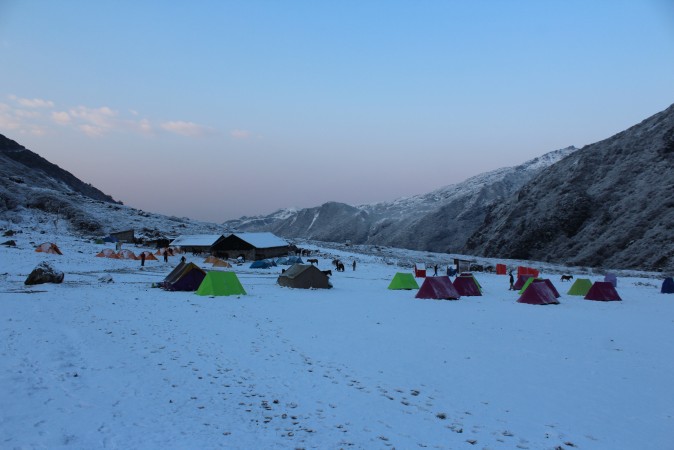
Kanchenjunga has far fewer teahouses than the Everest , Annapurna or Manaslu regions. Basic lodges exist in main villages — Ghunsa, Kambachen, Yamphudin — but accommodation gets very sparse above 4,000 metres. At Pangpema and Oktang, there are typically one or two basic teahouses open during peak season. In the off-season, you may need to carry a tent.
What to expect: Simple wooden or stone rooms with a basic mattress and blanket. Shared toilet facilities, often outside. Most lodges have a central heated dining room that becomes the social hub of the evening — this is where guides, porters, and trekkers from different groups share stories over butter tea and dal bhat.
Dal bhat (lentil soup with rice and vegetable curry) is the trekker's best friend and should be your main meal once or twice a day. It is cheap, filling, and endlessly refillable in most teahouses. You will also find noodle soups, Tibetan bread, fried potatoes, chapati, and momos (dumplings) in most stops. Western options like pasta or pancakes exist but are expensive and nutritionally inferior at altitude.
Carry energy snacks (nuts, dried fruit, chocolate, energy bars) for long days between villages.
Hydration: There are no ATMs anywhere beyond Taplejung town. Carry adequate Nepali Rupees for the entire trek — typically NPR 150,000–200,000 for a 21-day trek, including a 20% contingency buffer.
1. Clothing
The Kanchenjunga region is home to the Limbu and Rai peoples — among Nepal's most ancient indigenous communities. Their Kirant culture predates the arrival of Hinduism and Buddhism in Nepal, drawing from animist traditions that still govern festivals, farming rituals, and community life.
In villages like Yamphudin, you will see women weaving on traditional back-strap looms, producing the distinctive black-and-red Limbu textiles. Cardamom is the main cash crop in the lower valleys — the green pods drying on rooftops fill the air with a fragrant sweetness in autumn. Locally brewed tongba (a millet beer drunk hot through a wooden straw) is the social drink of the Limbu and is an essential cultural experience at lower altitudes.
In Ghunsa and the northern valley, the culture shifts to Tibetan Buddhist influence. You will find prayer wheels, mani walls, and small gompas (monasteries). The people here are closely related to Sherpa and Tibetan communities, and the dialect, food, and architecture reflect that border-crossing heritage.
Cultural respect tips:
The Kanchenjunga Conservation Area is one of Nepal's finest ecological reserves, covering 2,035 km² of habitat that spans from subtropical river valleys at 1,200 m to glaciated peaks above 8,000 m. The biodiversity compressed into this elevation gradient is extraordinary.
The region has been identified as an Important Bird Area by BirdLife International. Notable species include:
The transition from subtropical forest to alpine tundra over 3,000 metres of elevation gain is one of the most dramatic botanical experiences in the world.
Recognise AMS symptoms:
Recognise severe AMS (requires immediate descent):
These are medical emergencies. Descend immediately and do not wait for symptoms to "pass."
The Kanchenjunga region is extremely remote. There are no roads to the high camps, and helicopter rescue — while possible — is weather-dependent and expensive. Travel insurance covering high-altitude trekking and helicopter evacuation is not optional. Companies like World Nomads or AXA cover Nepal treks up to 6,000 m; verify coverage before purchasing.
The Kanchenjunga Conservation Area remains pristine largely because trekker numbers are low. Every visitor has a responsibility to keep it that way.
Orbit Nepal Adventure is committed to ethical, community-centred tourism. We hire locally, pay fair wages to all staff, and contribute a portion of every trek booking to conservation projects in the Kanchenjunga region.
Kanchenjunga is a photographer's dream — but it requires specific preparation.
For trekkers deciding between these two iconic Nepal treks, here is an honest side-by-side:
| Feature | Kanchenjunga Circuit | Everest Base Camp |
|---|---|---|
| Mountain height | 8,586 m (3rd highest) | 8,849 m (highest) |
| Trek duration | 20–24 days | 12–14 days |
| Max elevation (trekker) | 5,143 m (Pangpema) | 5,364 m (EBC) |
| Crowd level | Very low (dozens/week) | Very high (hundreds/day) |
| Teahouse infrastructure | Basic, sparse | Well-developed |
| Permit cost | ~$75–90 | ~$30–40 |
| Total cost | Higher (remote logistics) | Lower (established route) |
| Difficulty | Harder (longer, more remote) | Moderate to hard |
| Cultural experience | Richer (Limbu, Rai, Tibetan) | Sherpa culture |
| Wildlife | Richer (red panda, snow leopard) | Limited |
| Best for | Experienced trekkers seeking wilderness | First-time high-altitude trekkers |
The verdict: If you have already done Everest Base Camp and want something more challenging, more remote, and more culturally rich, Kanchenjunga is the natural next step. If this is your first Nepal trek, EBC or Annapurna Circuit is better preparation.
Related reading: Orbit Nepal Adventure Everest Base Camp Trek
Underestimating the duration. Trekkers who budget two weeks for the circuit almost always run out of time or push too hard, increasing altitude risk.
Not hiring a local guide. Not just because it is legally required — but because a knowledgeable Kanchenjunga guide can navigate trail junctions, communicate with locals in eastern dialects, and recognise AMS before you do.
Skipping the acclimatisation day at Ghunsa. One rest day here prevents two or three lost days (or a helicopter ride) higher on the route.
Carrying cash from Kathmandu, then running out. There are no ATMs between Taplejung and the end of the trek. Calculate your budget carefully and carry more than you think you need.
Arriving in Kathmandu without permits arranged. Permit processing takes 1–2 days minimum. Book with your agency well in advance and send all documents before you arrive in Nepal.
Buying cheap sleeping bags. A -10°C sleeping bag is not enough. Bring (or rent quality) -15°C gear. At Pangpema, temperatures regularly drop to -20°C at night.
Ignoring early AMS symptoms. Trekkers frequently minimise headaches at altitude, attributing them to dehydration or tiredness. Get your guide to assess any persistent symptom above 3,000 m.
Not building in a buffer day. Domestic flights in Nepal are frequently delayed by weather. Build at least one buffer day into your itinerary at both ends of the trek.
Beyond the well-known base camp destinations, the Kanchenjunga region rewards curious trekkers with some extraordinary lesser-known experiences:
👉 Yes — as of 22 March 2026, Nepal removed the minimum two-trekker rule for restricted area permits. A solo trekker can now obtain the Kanchenjunga Restricted Area Permit independently. However, a licensed guide from a registered agency remains mandatory on this trek for safety reasons. "Solo" means you do not need a second trekker — not that you trek without a guide.
👉 The Kanchenjunga Trek is rated strenuous to very strenuous. It is significantly more demanding than the Everest Base Camp trek due to its longer duration, greater remoteness, high passes on the circuit route, and limited infrastructure. Prior high-altitude trekking experience is strongly recommended.
👉 The North Base Camp only: 14–18 days from Taplejung. The full circuit (North + South Base Camps): 20–24 days. Add 1–2 days for travel from Kathmandu to trailhead and back.
👉 You need two permits: the Restricted Area Permit (RAP) (~USD 20/week) and the Kanchenjunga Conservation Area Permit (KCAP) (~USD 15 for foreigners). TIMS is waived for restricted area treks. Both must be arranged through a registered trekking agency.
👉 April–May (spring) and October–November (autumn) are the best times. April and October are the peak months for clear skies and comfortable temperatures.
👉Budget trekkers can do the North Base Camp in approximately USD 1,500–2,000 (all-inclusive package from Kathmandu). The full circuit typically runs USD 2,200–3,500. Luxury options can reach USD 5,000+ per person.
👉Yes. A licensed guide from a government-registered Nepal trekking agency is legally mandatory for all trekkers in the Kanchenjunga restricted area. This is a firm legal requirement, not a suggestion.
👉 Limited. NTC (Nepal Telecom) provides the most reliable signal and covers some sections of the lower valley. Above Ghunsa, connectivity becomes very unreliable. Do not rely on mobile communication for navigation or emergencies — your guide carries a VHF radio on reputable treks, and satellite communicators (like Garmin inReach) are recommended.
Absolutely, and it is legally required for your RAP permit. Your insurance must explicitly cover high-altitude trekking and helicopter evacuation. Standard travel insurance often does not cover activities above 4,000 m — verify carefully before purchasing.
Kanchenjunga is not for everyone. It demands real fitness, real commitment, and real respect for the mountains. But for those who make the journey, it delivers something increasingly rare in modern adventure travel: genuine wildness, minimal crowds, profound cultural encounters, and mountain scenery that does not appear on the poster at your local travel agency.
The world's third-highest mountain is waiting. The trails are open. And with the new 2026 solo permit rules, there has never been a better time to make the journey to Nepal's far east.
Ready to trek Kanchenjunga?
Orbit Nepal Adventure specialises in fully customised, permit-inclusive Kanchenjunga trek packages for all durations and group sizes. Our licensed guides have years of experience on eastern Nepal's remote trails and are committed to safe, responsible, and unforgettable adventure travel.
📲 Contact us directly on WhatsApp: Chat with us on WhatsApp
🌐 Visit: orbitnepaladv.com
📧 Email: orbitnepaladv@gmail.com
💬 Whatshapp: 9779841766021
We are based in Thamel, Kathmandu and respond to all WhatsApp messages within a few hours. Tell us your preferred dates, group size, and budget and we will build a custom Kanchenjunga itinerary for you — permits included, no hidden costs.