Thamel, Kathmandu, Nepal
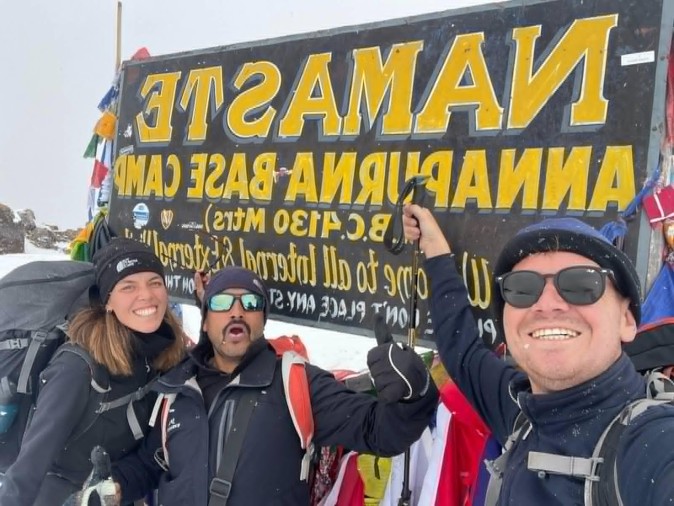
The Annapurna Base Camp Trek is a 110km round-trip trek in the Annapurna Conservation Area of central Nepal, reaching a maximum elevation of 4,130m (13,549ft) at the Annapurna Sanctuary — a glacial amphitheatre enclosed by 13 peaks above 6,000m, including Annapurna I (8,091m), the 10th highest mountain in the world.
The standard itinerary takes 10 days starting and ending in Pokhara, covering villages like Ghandruk, Chomrong, and Deurali before entering the sanctuary. You gain roughly 3,300m of total elevation from the trailhead at Nayapul (1,070m) to base camp.
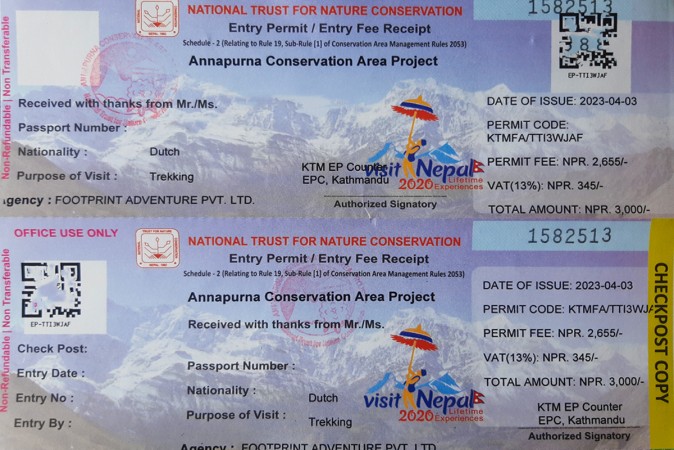
Two permits are required: the ACAP permit (NPR 3,000) and TIMS card (NPR 2,000). The best trekking seasons are March–May and September–November. Daily walking time averages 4–6 hours on well-marked trails — no technical climbing or ropes required.
Total cost ranges from NPR 55,000 (~$400) for independent trekkers to NPR 180,000 (~$1,320) for a fully guided package including porter, guide, accommodation, and meals.
|
Duration |
10 Days |
|
Total Distance |
~115 km (round trip) |
|
Maximum Elevation |
4,130m / 13,549ft (Annapurna Base Camp) |
|
Difficulty |
Moderate (suitable for fit beginners) |
|
Best Season |
March–May (Spring) | Sept–Nov (Autumn) |
|
Permits Required |
|
|
Start / End Point |
Pokhara |
|
Trek Style |
Teahouse / Lodge Trek |
Altitude: 827m | Travel: 6–7 hrs by road or 25 min by flight
Your ABC trek effectively begins the moment you leave Kathmandu's chaos behind. The road to Pokhara follows the Prithvi Highway, tracing the Trishuli and Marsyangdi river valleys — it's a scenic drive if you're not in a rush. Flying is faster, and the aerial view of the Annapurna range on a clear morning is worth the fare. Arrive in Pokhara, check into your hotel on Lakeside, and spend the evening sorting your gear. Pick up any last-minute supplies (trekking poles, snacks, SIM card top-up) from the shops along the main Lakeside road. Do not buy overpriced items at higher elevations.
💡Insider Tip: Book the tourist bus from Thamel (NPR 800–1,000) a day ahead. It's slower but far cheaper than a private car.
Gain: +1,113m | Walking: 3–4 hrs | Jeep to Nayapul: 1.5 hrs
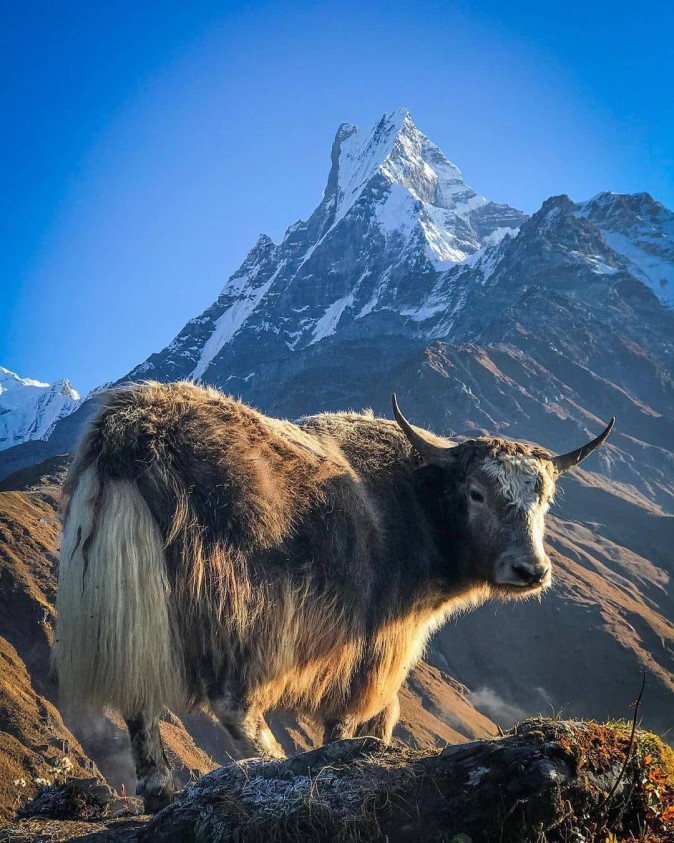
A jeep from Pokhara drops you at Nayapul (1,070m), where the trek begins in earnest. The trail climbs steadily through terraced farmland and rhododendron forest to Ghandruk — one of the most beautifully positioned Gurung villages in the Annapurna region. Stone-paved lanes, traditional houses with carved wooden windows, and your first clear sightlines of Annapurna South and Machapuchare reward the climb. Ghandruk is also home to the Gurung Museum if you arrive with daylight to spare — worth an hour of your evening.
💡Insider Tip: Get your ACAP and TIMS permits checked at the checkpoint here. Have them photocopied and stored separately in case originals get wet.
Gain/Loss: +230m net (descend to Kimche, climb to Chomrong) | Walking: 4–5 hrs
Today's trail dips before it climbs. You descend through terraced fields to Kimche, cross a suspension bridge over the Chomrong Khola, then face a steep stone-staircase ascent into Chomrong. It's a quad-burning hour — but Chomrong rewards you with some of the most panoramic views of Annapurna South and Machapuchare you'll get on the entire ABC trek. Chomrong is also the last major resupply point before the sanctuary. Stock up on snacks, backup batteries, and any medication here. The next few days push deeper into the mountains with limited options.
💡Insider Tip: Stay on the upper section of Chomrong for better mountain views and quieter lodges. The lower section gets crowded.
Gain: +430m | Walking: 5–6 hrs
This is where the Annapurna Sanctuary begins to reveal itself. You descend steeply from Chomrong to Sinuwa, then enter a narrow gorge flanked by dense bamboo and rhododendron forest. The trail follows the Modi Khola river, crossing it several times. You'll pass through Bamboo (2,310m) and Doban before reaching Himalaya village. The forest here is thick, moist, and atmospheric — on a foggy morning, it feels prehistoric. Keep your eyes open for Himalayan pheasants and, if you're lucky, signs of red pandas. Altitude begins to make itself felt today, so slow your pace.
💡Insider Tip: Start early. The trail between Sinuwa and Himalaya can get slippery after rain and is best walked in morning light.
Gain: +630m | Walking: 4–5 hrs
The vegetation thins as you push toward Deurali. Pass through Hinku Cave — a shallow rock shelter used as a rest stop — and Deorali, with its iconic waterfall views. The trail narrows and the air noticeably cools. By the time you reach Deurali at 3,230m, the tree line has been left behind and the surrounding peaks begin to dominate the skyline. This is a relatively short walking day by design — your body needs time to adjust to the altitude gain. Rest, hydrate, and eat well. No alcohol tonight.
💡 Insider Tip: Drink at least 3–4 litres of water today. Dehydration is one of the fastest routes to altitude sickness.
Gain: +900m | Walking: 5–6 hrs | The Big Day
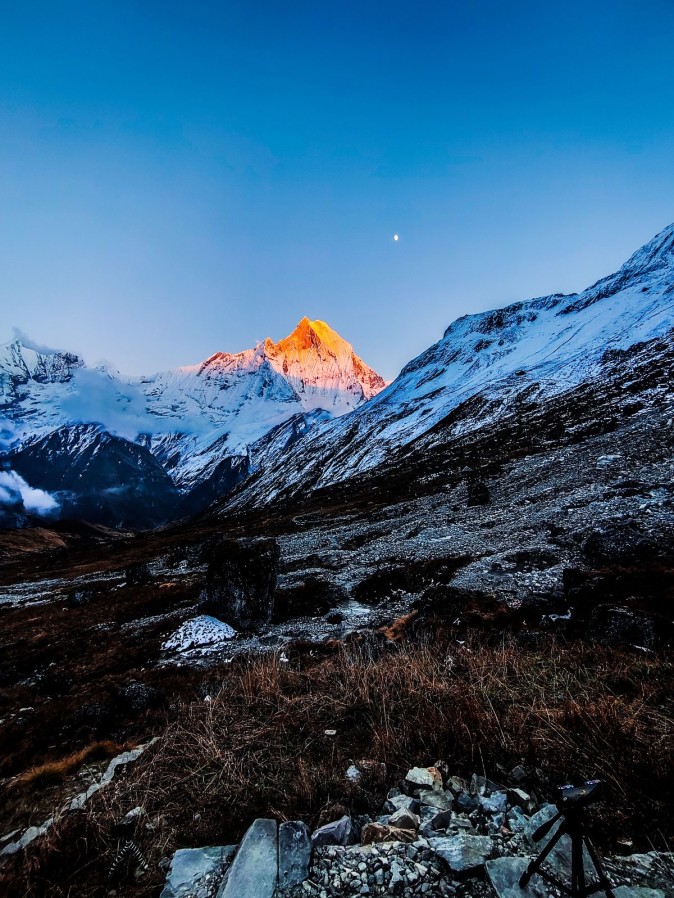
Today is what the entire Annapurna Base Camp Trek itinerary has been building toward. From Deurali, you pass Machhapuchhre Base Camp (MBC) at 3,700m — a natural rest point where the Fishtail peak fills the sky directly ahead. From MBC, the trail enters the sanctuary proper: a glacial bowl ringed by thirteen Himalayan peaks above 6,000m. The final push to ABC at 4,130m is demanding but extraordinary. When you arrive, you're standing in the Annapurna Sanctuary — completely enclosed by the highest mountains in the Annapurna massif. If the evening is clear, stay outside after sunset for one of the most astonishing starscapes you'll ever see.
💡 Insider Tip: Arrive at MBC before noon. Cloud typically rolls in from the south by early afternoon, blocking views. Early start = better visibility at ABC.
Loss: -1,820m | Walking: 6–7 hrs
Wake before sunrise and step outside one last time at 4,130m — the peaks glow amber before the sun fully clears the horizon. Then it's time to descend. The return follows the same trail back through MBC and Deurali. What took you multiple days to climb, you cover largely in one long descent. Knees take the brunt today — trekking poles are invaluable. Push past Himalaya to Bamboo for the night. The forest feels different on the return: familiar, quieter, like you're seeing an old friend again.
💡 Insider Tip: Tape your knees if you're prone to pain. The 1,800m descent is relentless on joints. Slow and steady beats fast and limping.
Loss: -530m | Walking: 4–5 hrs | Hot Spring Day
A shorter, gentler day — a reward for everything your legs have done. The trail drops back through Sinuwa and crosses the Modi Khola to Jhinu Danda, a small settlement perched above the river that is famous for one thing: natural hot springs. A 20-minute walk down from the village leads to riverside thermal pools. Soaking tired muscles in 40°C water with river mist and jungle sounds around you is one of the most satisfying experiences on any trek in Nepal. Budget two hours here. You've earned it.
💡 Insider Tip: Visit the hot springs in the late afternoon, after the midday tour groups have left. You'll often have the pools mostly to yourself.
Loss: -953m | Walking: 3–4 hrs to Nayapul | Jeep back: 1.5 hrs
The final walking day of your Annapurna Base Camp Trek itinerary brings you back to civilisation. The trail descends through Chomrong Khola valley to Siwai and on to Nayapul, where a jeep waits for the bumpy ride back to Pokhara. By mid-afternoon you'll be back on Lakeside, a hot shower behind you and a proper meal ahead. The contrast is surreal — 48 hours ago you were at 4,130m in a glacial amphitheatre; now you're watching boats drift across Phewa Lake. Celebrate. You've done it.
💡 Insider Tip: Book your jeep from Nayapul back to Pokhara before you start walking in the morning. They fill up quickly, especially in peak season.
Travel: Flight 25 min | Road 6–7 hrs
Your last day. Spend the morning at leisure in Pokhara — the lakeside cafés look different when you've just completed the ABC trek. Browse for gifts at the Lakeside market (local Thanka paintings, Gurung handicrafts, rhododendron honey). Then fly or drive back to Kathmandu. If you have a late flight out of the country, Thamel has enough restaurants and coffee shops to fill an evening comfortably.
💡 Insider Tip: Book your Pokhara–Kathmandu flight well in advance during peak season (October especially). Mountain weather causes frequent delays and seat scarcity.
If you're choosing between Nepal's two most iconic treks, check out our Annapurna Base Camp vs Everest Base Camp guide for a complete comparison.
You need two permits to complete the ABC trek. Both are checked at multiple points along the trail, so don't misplace them.
Both permits are obtained at the Nepal Tourism Board office in Kathmandu (Bhrikutimandap) or the TAAN office in Pokhara (Damside). Bring 2 passport-size photos and a photocopy of your passport.
Note: trekking permits Nepal regulations can change — always verify current fees at ntb.gov.np before your trip.
The best time to trek to Annapurna Base Camp depends on the kind of experience you're looking for. Whether you prefer vibrant landscapes, fewer crowds, or the clearest mountain views, each season has its own advantages and challenges.
The rhododendron forests are in full bloom — entire hillsides turn crimson and pink. Days are warm, nights are cool, and trail visibility is generally excellent. The most popular trekking season , so expect company on the trail and book lodges ahead in April.
Post-monsoon clarity means the sharpest mountain views of the year. October is peak season — busy but for good reason. Temperatures are stable and comfortable at all elevations. Book accommodation and flights early.
Cold, quiet, and surprisingly rewarding for experienced trekkers. Some high sections may have snow and ice — crampons may be needed above 3,500m. Many teahouses close above Dovan. Views are crystal-clear on dry days.
Not recommended. Heavy rainfall makes trails slippery and dangerous, leeches infest the forest sections, and mountain views are almost entirely blocked by cloud. Only experienced trekkers who know the terrain should attempt the ABC trek during monsoon.
For the best overall experience, plan your Annapurna Base Camp trek during spring (March–May) or autumn (September–November), when the weather is most stable and the mountain views are at their finest.
Pack light. Every kilogram you carry, you carry uphill. If you hire a porter (recommended), keep your daypack under 8kg.
Clothing & Gear
Health & Safety
Tech & Documents
The ABC trek reaches 4,130m — high enough for Acute Mountain Sickness-AMS to affect some trekkers, but manageable with a sensible pace.
Symptoms of AMS to watch for:
The golden rule: if symptoms worsen, descend immediately. Do not sleep at a higher altitude than where symptoms first appeared. The trek's profile is gradual enough that most trekkers acclimatize naturally by following the itinerary — but never push through AMS symptoms.
Hydrate consistently (3–4 litres per day), avoid alcohol above 3,000m, and eat carbohydrate-rich meals to fuel your body efficiently at altitude.
|
Category |
Budget (NPR) |
Mid-Range (NPR) |
Guided Package (NPR) |
|
ACAP Permit |
3,000 |
3,000 |
Included |
|
TIMS Card |
2,000 |
2,000 |
Included |
|
Accommodation/night |
500–800 |
1,200–2,000 |
Included |
|
Meals/day |
1,500–2,000 |
2,500–3,500 |
Included |
|
Guide/day |
— |
2,500–3,000 |
Included |
|
Porter/day |
— |
1,800–2,200 |
Included |
|
TOTAL (est.) |
~NPR 55,000 ($400) |
~NPR 90,000 ($660) |
~NPR 130,000– 180,000 ($950– $1,320) |
Note: All figures are approximate and based on 2025 rates. Transport (Kathmandu–Pokhara return) adds roughly NPR 8,000–15,000 depending on mode. Prices rise significantly during peak October season. Fpr cheaper trek yiu can try group treks too.
FOR THE BOOKING YOU CAN CONTACT US , Orbit Nepal Adventure!!!
Q. Is the Annapurna Base Camp Trek hard for beginners?
It's classified as moderate — the trails are well-marked, there's no technical climbing, and you walk 4–6 hours per day on average. A beginner with reasonable fitness who trains beforehand can complete it. The main challenges are the cumulative elevation gain and the altitude at ABC (4,130m). Following this Annapurna Base Camp Trek itinerary with a gradual ascent profile gives your body enough time to adjust.
Q. Do I need a guide for the ABC trek?
Not legally — the trail is well-marked and the teahouse system makes solo trekking straightforward. However, a local guide adds significant value: navigation confidence in bad weather, emergency support at altitude, cultural context, and access to the best lodges. If it's your first Nepal trek, a guide is strongly recommended.
Q. What is the best month for the ABC trek?
October is the most popular month: post-monsoon skies are clear, temperatures are comfortable, and rhododendron berries line the trail. April is a close second, with blooming rhododendrons and spring clarity. Both months require advance booking for popular lodges.
Q. How much does the Annapurna Base Camp Trek cost?
A solo budget trekker can complete the 10-day ABC trek for approximately NPR 55,000–65,000 ($400–480 USD) including permits, food, and accommodation. A fully guided package with a reputable Nepal trekking agency runs NPR 130,000–180,000 ($950–1,320 USD) per person including guide, porter, all meals, and transfers.
Q. Are there ATMs on the ABC trek route?
No. The last reliable ATMs are in Pokhara. Withdraw enough cash before starting ; lodges and teahouses above Nayapul are cash-only. Budget roughly NPR 3,000–4,000 per day for food, accommodation, and hot showers.
Q. How fit do I need to be for the ABC trek?
You should be able to walk 5–6 hours on consecutive days carrying a daypack. Pre-trek training over 4–6 weeks , hiking with a loaded pack, stair climbing, and cardio makes the experience significantly more enjoyable. The trek is achievable without being an athlete, but arriving unprepared makes every uphill section miserable.
Q. What permits do I need for the ABC trek?
Two permits are required: the ACAP (Annapurna Conservation Area Project) permit at NPR 3,000, and the TIMS (Trekkers' Information Management System) card at NPR 2,000. Both are available in Kathmandu and Pokhara and must be carried with you at all times — checkpoints are frequent on this route. See our detailed guide on Nepal trekking permits for current fees and issue locations.
📲 Contact us directly on WhatsApp: Chat with us on WhatsApp
🌐 Visit: orbitnepaladv.com
📧 Email: orbitnepaladv@gmail.com
💬 Whatshapp: +977-9841766021