Thamel, Kathmandu, Nepal
Annapurna Base Camp Trek Itinerary: Day-by-Day 2026 Guide
The trail out of Pokhara starts easy — rice terraces, stone farmhouses, the Modi Khola flashing between trees. By the third day it isn't easy anymore. The valley narrows into a gorge, bamboo forest closes overhead, and the air starts carrying a chill that wasn't there in Chhomrong. Then, somewhere past Machhapuchhre Base Camp, the walls of the gorge fall away and you're standing inside a ring of 6,000–8,000 m peaks that seems to close in from every direction at once. That's the Annapurna Base Camp Trek — one route, roughly a week and a half, and a destination that very few treks in Nepal can match for how suddenly the landscape changes shape around you.
| Feature | Details |
|---|---|
| Trek Name | Annapurna Base Camp (ABC) Trek / Annapurna Sanctuary Trek |
| Region | Annapurna Conservation Area, western Nepal |
| Maximum Elevation | 4,130 m / 13,549 ft |
| Starting City | Pokhara |
| Trailhead | Nayapul (1,070 m) or Kimche/Ghandruk road-head |
| Duration | 7–12 days on trail; 8 days is most common |
| Round-Trip Distance | Approx. 90–115 km, route dependent |
| Difficulty | Moderate |
| Best Seasons | March–May and September–November |
| Accommodation | Teahouses/lodges throughout |
| Guide Requirement | Currently mandatory for the Annapurna Conservation Area — confirm before departure |
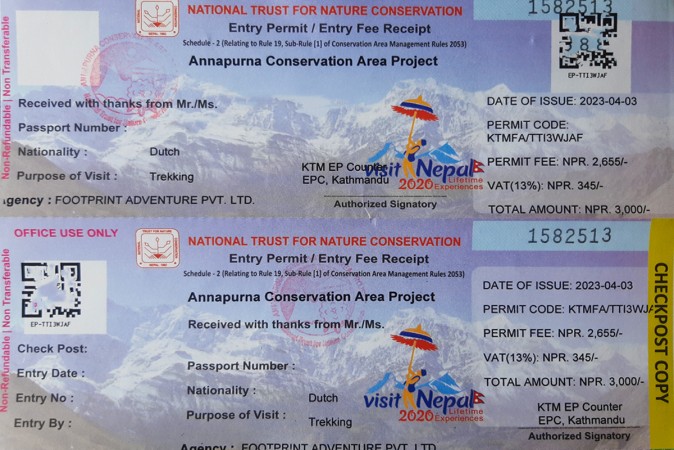
| Permits | ACAP + TIMS card |
There is no single "official" ABC itinerary — road access has crept further into the hills over the past decade, so the exact trailhead shifts with the season. The 8-day version below is the itinerary we run most often. Common 7-day and 10–12 day variations are noted at the end.
Elevation: 820 m → 1,940 m | Distance: ~10 km |
Walking Time: 4–5 hrs | Difficulty: Moderate | Stay: Ghandruk
A jeep or local bus takes you from Pokhara to the trailhead, then the trail climbs through terraced farmland and Gurung farmhouses into Ghandruk — one of the largest traditional Gurung villages in the Annapurna region, with clear-day views of Annapurna South and Machhapuchhre.
Elevation: 1,940 m → 2,210 m | Distance: ~10–11 km |
Walking Time: 5–6 hrs | Difficulty: Moderate | Stay: Chhomrong
The trail drops to cross the Kimrong Khola, then climbs steadily to Chhomrong — the last major settlement before the Annapurna Sanctuary corridor, perched with panoramic views of Annapurna South and Hiunchuli.
Elevation: 2,210 m → 2,505 m | Distance: ~12–13 km |
Walking Time: 5–6 hrs | Difficulty: Moderate–strenuous | Stay: Dovan/Bamboo
A steep stone staircase drops to the river before the trail enters dense bamboo and rhododendron forest — cooler, damper, and noticeably quieter, with langurs often seen moving through the canopy.
Elevation: 2,505 m → 3,230 m | Distance: ~8–9 km |
Walking Time: 4–5 hrs | Difficulty: Moderate, altitude jump | Stay: Deurali
Forest thins as the trail climbs the narrowing gorge, passing Himalaya lodge before the first proper wall of peaks — Annapurna III, Gangapurna, Hiunchuli — comes into view.
💡 Insider Tip: This day gains close to 700 m — walk slower than feels necessary and drink more water than feels necessary.
Elevation: 3,230 m → 4,130 m | Distance: ~8–9 km |
Walking Time: 5–6 hrs | Difficulty: Strenuous | Stay: Annapurna Base Camp
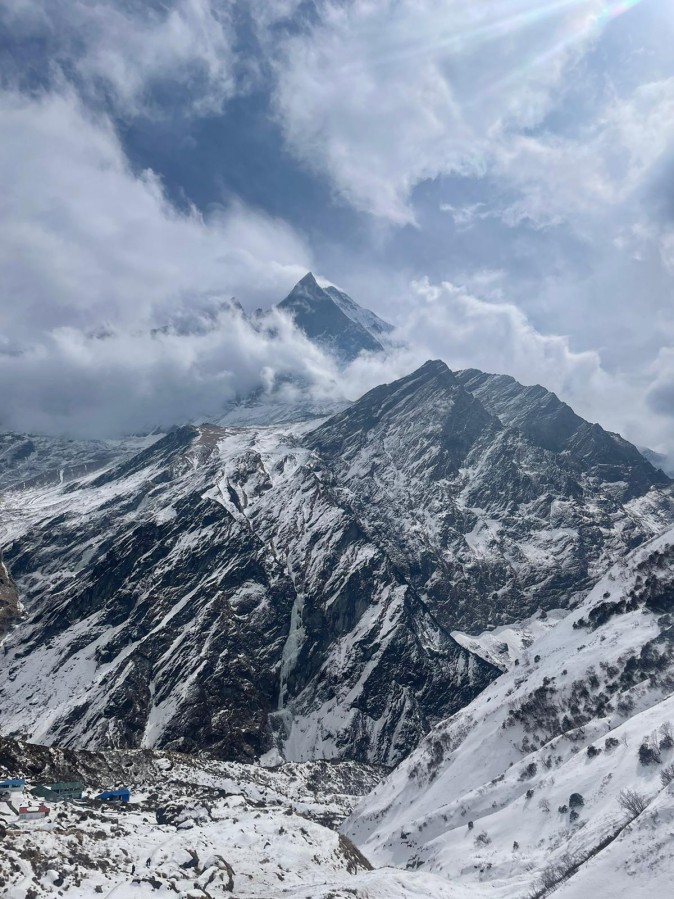
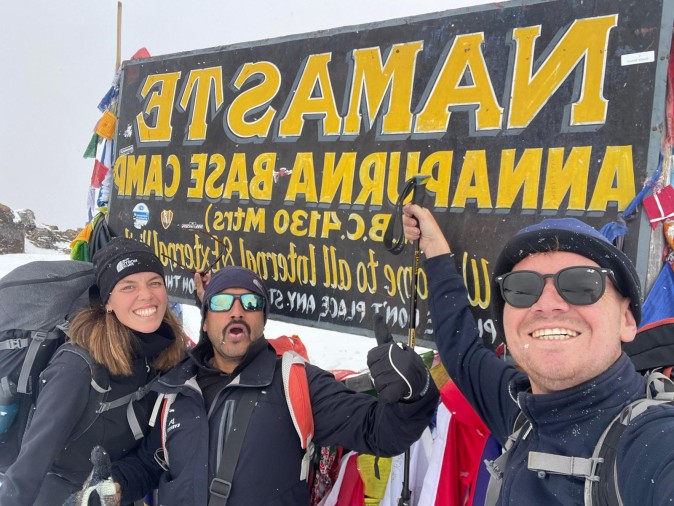
The trail climbs to Machhapuchhre Base Camp (3,700 m), where Fishtail peak rises directly overhead, before roughly 90 minutes more into the Annapurna Sanctuary — a glacial amphitheatre ringed by thirteen 6,000+ m peaks, including Annapurna I at 8,091 m.
💡 Insider Tip: Aim to arrive at ABC in the early-to-mid afternoon, before clouds typically build, for the best chance at a full 360° view.
Elevation: 4,130 m → 2,350 m | Distance: ~16–17 km |
Walking Time: 6–7 hrs | Difficulty: Strenuous descent | Stay: Bamboo
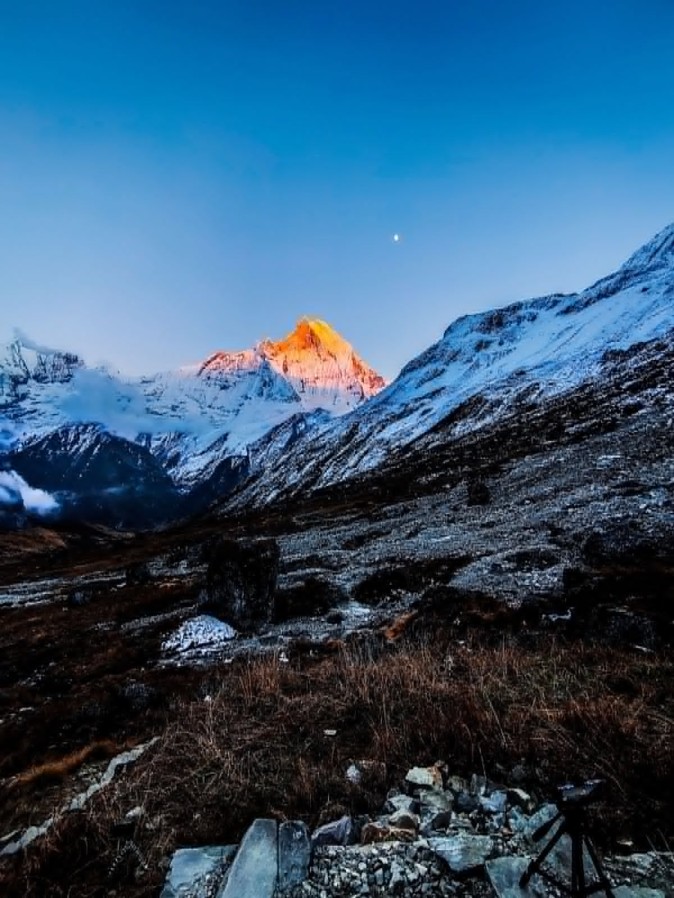
After sunrise over the sanctuary — usually the most-photographed moment of the trip — the long retreat begins through MBC, Deurali, and the gorge. Trekking poles earn their keep here.
Elevation: 2,350 m → 1,780 m | Distance: ~12 km | Walking Time: 4–5 hrs | Difficulty: Easy–moderate | Stay: Jhinu Danda
The trail rejoins the lower Modi Khola valley at Jhinu Danda. A 20-minute walk to the riverbank leads to natural hot spring pools — the best-earned soak on any trek in Nepal.
Elevation: 1,780 m → 1,070 m → 820 m | Distance: ~10 km + drive |
Walking Time: 3–4 hrs | Difficulty: Easy | Stay: Pokhara
A gentle descent through farmland reaches Nayapul, the trek's road-head, followed by a 60–90 minute drive back to Pokhara.
Road access above Nayapul shifts periodically as new jeep tracks are built — always confirm the current trailhead with your guide before departure.
Pokhara → Nayapul/Kimche → Ghandruk → Chhomrong → Bamboo/Dovan → Deurali → Machhapuchhre Base Camp → Annapurna Base Camp → Jhinu Danda → Nayapul → Pokhara
It's an out-and-back trek with a loop element — climbing via Ghandruk and Chhomrong, descending via Jhinu Danda for variety and the hot-spring reward.
Pokhara (820 m) → Ghandruk (1,940 m) → Chhomrong (2,210 m) → Bamboo (2,350 m) → Deurali (3,230 m) → MBC (3,700 m) → Annapurna Base Camp (4,130 m)
Altitude becomes a genuine consideration above roughly 3,000 m — from Deurali onward. Below that, stone staircases and forest climbs are the main physical demand; above it, pacing and hydration matter more than fitness.
ABC is graded moderate. Expect 4–7 hours of walking most days, long stone staircases, uneven forest terrain, cold nights above Deurali, and a real but manageable altitude factor above 3,000 m. Reasonably fit beginners generally do fine with a few months of walking or stair-climbing preparation beforehand. It is not "easy for everyone" — but it's one of the more approachable treks in Nepal that still reaches genuine high altitude.
| Season | Conditions |
|---|---|
| Spring (Mar–May) ✅ | Rhododendron blooms, mild lower valley, good visibility (light haze possible late May) |
| Autumn (Sep–Nov) ✅ | Clearest skies of the year, cool days, cold nights, busiest season |
| Winter (Dec–Feb) ⚠️ | Cold, likely snow above Deurali, quieter trails, possible short closures |
| Monsoon (Jun–Aug) ❌ | Rain, mud, leeches, limited mountain visibility, possible road/landslide disruption |
For a first-time trekker, autumn or spring are the seasons worth planning around.
| Cost Component | Notes | Approx. Cost (per person) |
|---|---|---|
| ACAP Permit | Fixed government fee, paid once | NPR 3,000 (~US$23) |
| TIMS Card | Fixed government fee, paid once | NPR 2,000 individual / NPR 1,000 group (~US$15 / ~US$8) |
| Guide/porter | Daily rate, varies by season and group size | Guide: ~US$25–35/day · Porter: ~US$20–25/day |
| Teahouse accommodation | Often nominal or free with meals purchased | ~US$2–10/night |
| Meals | Priced per dish, rises with altitude | ~US$25–35/day (dal bhat, noodles, soups) |
| Transport (Pokhara–trailhead) | Jeep or bus, each direction | Local bus: ~US$3–5 · Private jeep: ~US$15–30 |
| Water, charging, Wi-Fi | Small per-use fees above Chhomrong | ~US$1–3 each, per use |
| Travel insurance | Must cover altitude trekking + evacuation | ~US$30–100 for an 8–10 day trip |
| Equipment rental | Sleeping bag, down jacket if needed | ~US$1–3/day per item |
| Tips | Customary for guide/porter at trip end | ~US$8–10/day for guide, ~US$5–7/day for porter (or a lump sum at trip end) |
| Total (typical, per person) | Guided all-inclusive package vs. independent trekking | Guided: ~US$700–1,200 · Independent: ~US$400–600 for 8 days |
Independent trekkers arranging their own permits and teahouses generally spend less than those booking a fully guided, all-inclusive package. Current pricing for our Annapurna Base Camp Trek Package is best confirmed directly, since permit fees and transport costs are adjusted periodically.
Guide requirements for foreign trekkers in conservation areas have tightened in recent years. Confirm current permit and guide rules with the Nepal Tourism Board or your operator before departure.
ABC is a teahouse trek — no camping gear needed. Rooms are simple twin-share with a mattress and blanket (bring your own sleeping bag for warmth above Deurali). Shared toilets are standard; hot showers usually cost extra lower down and become less reliable near ABC. Wi-Fi and electricity exist but slow down and cost more with elevation.
Meals: dal bhat (with refills) is the most reliable choice at altitude, alongside noodles, fried rice, soups, momos, eggs, and Tibetan-style bread. Prices rise the higher you climb, since everything is carried in.
Clothing: Base layers, fleece/insulated mid-layer, waterproof shell, trekking trousers, warm hat, gloves
Footwear: Broken-in waterproof boots, camp shoes, wool socks
Sleeping & Comfort: 3-season sleeping bag (-10°C rated), earplugs
Trekking Equipment: Poles, daypack (30–40L), headlamp, water bottles, purification tablets
Personal Items: Sunscreen, lip balm SPF, high-altitude sunglasses, toiletries
Electronics: Power bank, adapter
Documents: Passport, permit copies, insurance details
First-Aid: Personal medications, blister plasters, AMS medication as advised by a doctor, rehydration salts
AMS becomes a realistic concern above roughly 2,500–3,000 m — around Deurali on this itinerary.
Watch for headache, nausea, dizziness, or fatigue that worsens rather than improves with rest. The standard response is to stop ascending, rest, and descend if symptoms persist. Because evacuation options near ABC are limited to trail descent or helicopter, travel insurance covering high-altitude trekking and emergency evacuation is essential. This is general safety guidance, not medical advice.
Ascend gradually, hydrate more than feels necessary, rest when your body asks for it.
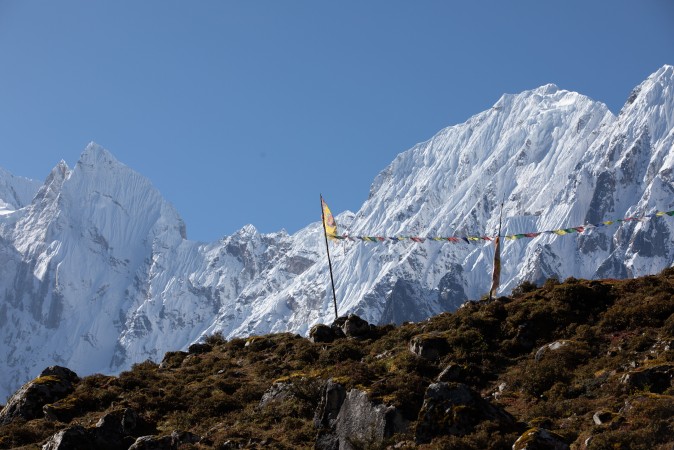
Terraced Gurung villages give way to rhododendron and bamboo forest, then a narrowing stone gorge, then the Annapurna Sanctuary itself: a glacial bowl ringed by Annapurna I, Annapurna South, Hiunchuli, and Machhapuchhre. Hot springs at Jhinu Danda and Gurung culture in Ghandruk and Chhomrong round out a landscape that changes character almost daily.
| Feature | Annapurna Base Camp | Annapurna Circuit |
|---|---|---|
| Duration | 7–12 days | 12–18 days |
| Max Elevation | 4,130 m | 5,416 m (Thorong La) |
| Landscape | Forest, gorge, glacial sanctuary | Valley to high desert and pass |
| Difficulty | Moderate | Moderate–strenuous |
| High Pass | No | Yes — Thorong La |
| Best For | Shorter trips, first-time high-altitude trekkers | Longer trips, more altitude & variety |
We're a Nepal-based trekking team operating out of Pokhara and Kathmandu, and the Annapurna region is where most of our guides learned the trail.
That means itineraries built around realistic pacing, guides who can read altitude symptoms early, straightforward communication about cost and inclusions, and a preference for teahouses and porters from the communities the trail passes through. We won't promise a guaranteed outcome no mountain trek can guarantee — but we'll tell you plainly what to expect before you commit.
Q. How many days do you need for Annapurna Base Camp?
➤ Most itineraries run 7 to 12 days on the trail. Eight days is the most common realistic option.
Q. How difficult is the Annapurna Base Camp Trek?
➤ Moderate — 4–7 hours of walking most days, long stone staircases, and a manageable altitude factor above roughly 3,000 m.
Q. What is the highest altitude of the ABC Trek?
➤ Annapurna Base Camp sits at 4,130 m (13,549 ft).
Q. What is the best month for Annapurna Base Camp?
➤ October–November and March–April generally offer the clearest, most stable weather.
Q. Can beginners do the ABC Trek?
➤ Yes, with reasonable fitness and preparation. It's one of the more approachable treks in Nepal that still reaches genuine high altitude.
Q. How much does the Annapurna Base Camp Trek cost?
➤ Cost depends on whether you trek independently or with a guided package — see the cost breakdown above for the components involved.
Q. Do I need a guide for Annapurna Base Camp?
➤ Guide requirements for the Annapurna Conservation Area have tightened for foreign trekkers; confirm current rules before departure. Guide is suggested.
Q. What permits are required?
➤ The ACAP permit and TIMS card are currently required.
Q. Is Annapurna Base Camp safe?
➤ It's one of the lower-risk high-altitude treks in Nepal, but good pacing, hydration, and evacuation-inclusive insurance materially reduce the risk.
Q. What should I pack for the ABC Trek?
➤ Layered clothing, waterproof boots, a warm sleeping bag, trekking poles, and sun protection — see the full packing list above.
Q. Is there Wi-Fi and electricity on the trek?
➤ Generally yes, but it slows down and costs more at higher elevations and isn't fully reliable near ABC.
Q. Can the ABC Trek be done during winter?
➤ Yes, though expect cold temperatures, likely snow above Deurali, and occasional short trail disruptions.
Ready to walk into the heart of the Annapurna Sanctuary?Contact Orbit Nepal Adventure today for customized itineraries for easier and adventurous trek.
📲 Contact us directly on WhatsApp: Chat with us on WhatsApp
🌐 Visit: orbitnepaladv.com
📧 Email: orbitnepaladv@gmail.com
💬 Whatshapp: 977-9841766021
Our Package : Annapurna Base Camp