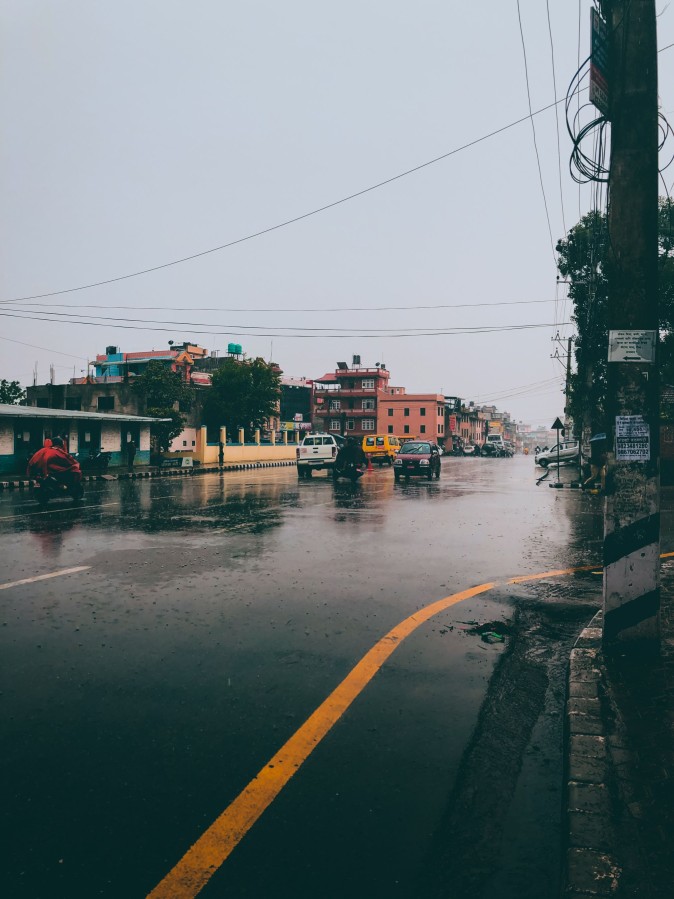
Thamel, Kathmandu, Nepal
Planning a trek in the Himalayas is exciting — but before you lace up your boots, there's one piece of paperwork you can't skip: your trekking permits. If you're searching "Nepal trekking permits" for the first time, don't worry. This guide breaks everything down in plain English, region by region, so you know exactly what to buy, where to buy it, and how much it costs.
Nepal doesn't require permits to make your trip harder. It requires them because the Himalayas are a shared, fragile, and sometimes dangerous place — and permits are how the country manages that responsibility.Here's the short version of why permits exist:
Permit requirements are not one-size-fits-all. What you need for Everest Base Camp differs from Upper Mustang or the Kanchenjunga Base Camp Trek. That's exactly what this guide untangles.
💡 Quick note: Nepal's permit system has changed more in the last three years than in the previous decade — TIMS rules, guide requirements, and restricted-area group sizes have all shifted since 2023. Some older blogs online are already out of date. This guide reflects the rules as they stand in 2026, and Orbit Nepal Adventure keeps its permit paperwork updated season by season, so you never have to guess.
Every major trekking route in Nepal passes through at least one of these protected categories:
| Category | What It Protects | Example Regions |
|---|---|---|
| National Parks | Wildlife, forests, high-altitude ecosystems | Sagarmatha (Everest), Langtang, Makalu Barun, Shivapuri Nagarjun |
| Conservation Areas | Community-managed mixed-use landscapes | Annapurna, Manaslu, Kanchenjunga |
| Restricted Areas | Border-sensitive, culturally protected regions | Upper Mustang, Upper Dolpo, Nar Phu, Tsum Valley, Humla |
On top of habitat and cultural protection, permits also support:
Because trekking in Nepal means crossing several of these zones back-to-back, most treks require two or more permits used together — not just one.
| Permit | Purpose | Who Needs It | Cost (Foreigner) | Where to Obtain |
|---|---|---|---|---|
| TIMS Card | Trekker registration & safety tracking | Select non-restricted routes (varies) | NPR 2,000 / NPR 1,000 | NTB or via agency |
| Sagarmatha National Park Permit | Entry to Everest region | EBC, Three Passes, Gokyo | NPR 3,000 | NTB Kathmandu / Monjo |
| Khumbu Pasang Lhamu Rural Municipality Permit | Local entry fee, replaced TIMS in Khumbu | All Khumbu trekkers | NPR 3,000 | Lukla / Monjo only |
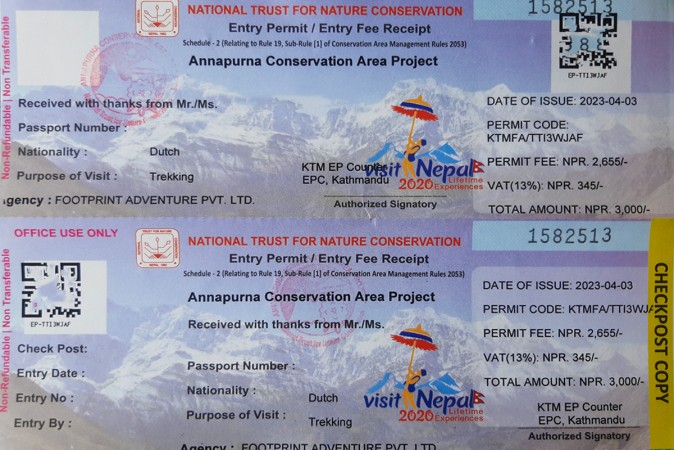
| ACAP | Entry to Annapurna Conservation Area | ABC, Circuit, Poon Hill, Mardi Himal | NPR 3,000 | NTB Kathmandu / Pokhara |
| Langtang National Park Permit | Entry to Langtang National Park | Langtang, Gosaikunda, Tamang Heritage | NPR 3,000 | NTB / Dhunche |
| Makalu Barun National Park Permit | Entry to Makalu Barun National Park | Makalu Base Camp | NPR 3,000–4,000 | NTB / local checkpoint |
| Shivapuri National Park Permit | Entry to Shivapuri Nagarjun (select routes) | Helambu via Sundarijal | NPR 1,000 | Sundarijal gate |
| Restricted Area Permit (RAP) | Access to border-sensitive regions | Mustang, Dolpo, Nar Phu, Tsum, Humla | USD 20–500+ | Immigration, via agency |
| MCAP | Entry to Manaslu Conservation Area | Manaslu Circuit | NPR 3,000 | NTB / agency |
| KCAP | Entry to Kanchenjunga Conservation Area | Kanchenjunga Base Camp | NPR 2,000–3,000 | NTB / agency |
▪ TIMS (Trekkers' Information Management System)
TIMS was once required almost everywhere. That's no longer true. Since 2018, the Khumbu region has used the Khumbu Pasang Lhamu Rural Municipality permit instead, and by 2026 several agencies report Annapurna checkpoints verifying ACAP only. TIMS is still applied in Langtang and some far-western regions. Enforcement genuinely varies by season and checkpoint — always confirm current TIMS status for your route with your agency.
▪ Sagarmatha National Park Permit
Your ticket into the Everest region's UNESCO World Heritage-listed national park, covering the trail to Everest Base Camp and Gokyo. Checked at the Monjo gate.
▪ Khumbu Pasang Lhamu Rural Municipality Permit.
A locally administered entry fee for the Khumbu region, named after Pasang Lhamu Sherpa, the first Nepali woman to summit Everest. Only sold in Lukla or Monjo — not in Kathmandu.
▪ ACAP
Covers Nepal's largest protected area (7,629 sq km), including the Annapurna Circuit, Annapurna Base Camp, Poon Hill, and Mardi Himal.
▪ Langtang National Park Permit
Required for Langtang Valley, Gosaikunda, and Tamang Heritage routes.
▪ Makalu Barun National Park Permit
Covers the remote trail to Makalu Base Camp, spanning tropical forest to glacial terrain.
▪ Shivapuri National Park Permit
Only relevant if starting from Sundarijal into Helambu — the standard Langtang route via Syabrubesi doesn't need it.
▪ Restricted Area Permit (RAP)
A special government permit for border-adjacent or culturally sensitive regions, issued only through registered agencies, always bundled with a mandatory licensed guide.
▪ MCAP
Required alongside the RAP for the Manaslu Circuit — MCAP alone doesn't grant access to the restricted section.
▪ KCAP
Required for Kanchenjunga Base Camp, alongside the region's RAP.
Restricted Area Permits (RAPs) apply to regions that sit near sensitive international borders or protect culturally isolated communities. They're deliberately more expensive and harder to obtain than standard park permits — that's by design, to limit visitor numbers and preserve these areas.
| Region | Permit Fee | Min. Group Size | Guide Mandatory | Restricted Area |
|---|---|---|---|---|
| Upper Mustang | USD 500 (10 days) + USD 50/day | Solo allowed (2026) | Yes | Yes |
| Upper Dolpo | USD 500 (10 days) + USD 50/day | Solo allowed (2026) | Yes | Yes |
| Manaslu | USD 75–100 (7 days) + USD 10–15/day | Solo allowed (2026) | Yes | Yes |
| Nar Phu | ~USD 90–150 (first week) | Solo allowed (2026) | Yes | Yes |
| Kanchenjunga | USD 10–20/week | Solo allowed (2026) | Yes | Yes |
| Tsum Valley | ~USD 35–40/week | Solo allowed (2026) | Yes | Yes |
| Humla | ~USD 50/week (route-dependent) | Solo allowed (2026) | Yes | Yes |
| Lower Dolpo | USD 10/week | Solo allowed (2026) | Yes | Yes |
| Makalu (restricted sections) | Assessed with agency | Solo allowed (2026) | Yes | Partial |
Why these permits exist: Restricted areas sit close to Nepal's borders with Tibet (China) or protect communities with distinct cultures and limited infrastructure. The government caps and monitors access to reduce environmental strain, protect these communities from over-tourism, and maintain border security. RAPs can only be arranged by a registered trekking agency and always come bundled with a licensed guide requirement.
⚠️ 2026 update: Nepal previously required a minimum of two trekkers to apply for most restricted-area permits. That rule has been relaxed — solo foreign trekkers can now apply individually for Upper Mustang, Manaslu, Kanchenjunga, Dolpo, Tsum Valley, and Nar Phu permits. The licensed-guide-and-registered-agency requirement, however, has not changed and remains firmly in place.
Documents Required
Option 1: Through Us, Orbit Nepal Adventure. We handle the entire permit process for every trek we run — national park, conservation, and restricted area permits alike. You send your passport copy and photos; we handle the paperwork, queueing, and checkpoint logistics.
Option 2: Nepal Tourism Board (NTB). For non-restricted permits (Sagarmatha, ACAP, Langtang, Makalu Barun, MCAP, KCAP, TIMS), apply in person at the NTB office in Kathmandu or Pokhara.
Option 3: Department of Immigration (Restricted Areas). Restricted Area Permits are issued exclusively by the Department of Immigration, and only through a registered trekking agency. There is no independent or walk-in option — it's a legal requirement, not a convenience recommendation.
| Permit | Foreigners | SAARC | Nepali | Validity |
|---|---|---|---|---|
| TIMS Card | NPR 1,000–2,000 | NPR 1,000–2,000 | Not required | Full trek |
| Sagarmatha National Park | NPR 3,000 | NPR 1,500 | NPR 100 | Single entry |
| Khumbu Pasang Lhamu Rural Municipality | NPR 3,000 | NPR 3,000 | NPR 100 | Single entry |
| ACAP | NPR 3,000 | NPR 1,000 | NPR 100 | Single entry |
| MCAP | NPR 3,000 | NPR 1,000 | NPR 100 | Single entry |
| KCAP | NPR 2,000–3,000 | NPR 1,000 | NPR 100 | Single entry |
| Langtang National Park | NPR 3,000 | NPR 1,500 | NPR 100 | Single entry |
| Makalu Barun National Park | NPR 3,000–4,000 | NPR 1,500–2,000 | NPR 100 | Single entry |
| Shivapuri Nagarjun National Park | NPR 1,000 | NPR 500 | NPR 100 | Single entry |
| Upper Mustang / Upper Dolpo RAP | USD 500 + USD 50/day | Same as foreigner | N/A | Tied to trek dates |
| Manaslu RAP | USD 75–100 + USD 10–15/day | Same as foreigner | N/A | Tied to trek dates |
Rates are reviewed periodically by Nepali authorities — Orbit Nepal Adventure confirms live pricing before every booking.
Costs are per foreign trekker unless noted; always confirm current rates with your agency, since fees are reviewed periodically.
| Permits required | Sagarmatha National Park Permit + Khumbu Pasang Lhamu Rural Municipality Permit |
| Permit cost | NPR 3,000 + NPR 3,000 = NPR 6,000 (~USD 45) |
| Validity | Single entry, covers full trek duration |
| Where to obtain | NTB Kathmandu (Sagarmatha) + Lukla/Monjo (Khumbu) |
| Guide requirement | Mandatory since 2023 |
| Special rules | No TIMS required in the Khumbu |
| Difficulty | Moderate–challenging, high altitude (5,364 m) |
| Best season | March–May, September–November |
| Who should trek | Fit beginners with prior high-altitude prep |
Full itinerary details: Everest Base Camp Trek
| Permits required | MCAP + Manaslu RAP (+ ACAP for the Dharapani side) |
| Permit cost | MCAP NPR 3,000 + RAP USD 100/7 days (Sep–Nov) or USD 75/7 days (Dec–Aug), plus daily rate after |
| Validity | RAP tied to registered dates |
| Where to obtain | NTB Kathmandu, via registered agency only |
| Guide requirement | Mandatory (restricted area) |
| Special rules | Solo RAP applications now permitted with guide + agency |
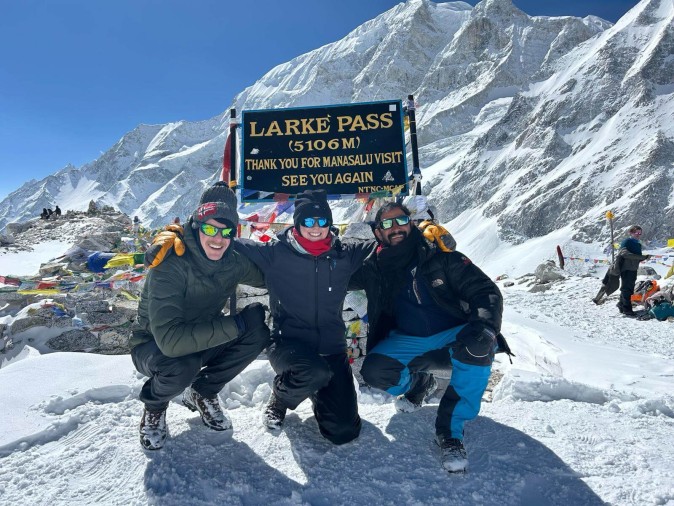
| Difficulty | Challenging, Larkya La Pass at 5,106 m |
| Best season | September–November, March–May |
| Who should trek | Experienced trekkers seeking a quieter alternative to Annapurna |
Full itinerary details: Manaslu Circuit Trek
| Permits required | KCAP + Kanchenjunga RAP |
| Permit cost | KCAP NPR 2,000–3,000 + RAP ~USD 20/week (peak) or USD 10/week (off-season) |
| Validity | Tied to registered trek dates |
| Where to obtain | NTB Kathmandu, via registered agency only |
| Guide requirement | Mandatory (restricted area) |
| Special rules | One of the most affordable restricted-area permits in Nepal |
| Difficulty | Challenging, long and remote |
| Best season | April–May, October–November |
| Who should trek | Experienced trekkers wanting true wilderness solitude |
Full itinerary details: Kanchenjunga Base Camp Trek
| Permits required | ACAP |
| Permit cost | NPR 3,000 |
| Validity | Single entry, covers full trek |
| Where to obtain | NTB Kathmandu or Pokhara |
| Guide requirement | Mandatory since 2023 |
| Special rules | No RAP needed — not a restricted region |
| Difficulty | Moderate, 4,130 m max altitude |
| Best season | March–May, September–November |
| Who should trek | First-time trekkers wanting big mountain views without extreme altitude |
Full itinerary details: Annapurna Base Camp Trek
| Permits required | ACAP |
| Permit cost | NPR 3,000 |
| Validity | Single entry, covers full trek |
| Where to obtain | NTB Kathmandu or Pokhara |
| Guide requirement | Mandatory since 2023 |
| Special rules | Shares ACAP with ABC and the Annapurna Circuit |
| Difficulty | Easy–moderate, 4,500 m viewpoint |
| Best season | March–May, September–November |
| Who should trek | Beginners with limited time (5–7 days) |
Full itinerary details: Mardi Himal Trek
| Permits required | ACAP |
| Permit cost | NPR 3,000 |
| Validity | Single entry, covers full trek |
| Where to obtain | NTB Kathmandu or Pokhara |
| Guide requirement | Mandatory since 2023 |
| Special rules | Shortest and easiest ACAP trek |
| Difficulty | Easy, suitable for families |
| Best season | Year-round, best March–May and October–November |
| Who should trek | Absolute beginners and families |
Full itinerary details: Poon Hill Trek
| Permits required | ACAP |
| Permit cost | NPR 3,000 |
| Validity | Single entry, covers full trek |
| Where to obtain | NTB Kathmandu or Pokhara |
| Guide requirement | Mandatory since 2023 |
| Special rules | Thorong La Pass (5,416 m) demands proper acclimatization |
| Difficulty | Challenging, high pass crossing |
| Best season | March–May, September–November |
| Who should trek | Trekkers wanting classic Nepal diversity, from subtropical villages to high desert |
Full itinerary details: Annapurna Circuit Trek
| Permits required | Langtang National Park Permit + TIMS |
| Permit cost | NPR 3,000 + TIMS NPR 1,000–2,000 |
| Validity | Single entry, covers full trek |
| Where to obtain | NTB Kathmandu or Dhunche checkpoint |
| Guide requirement | Mandatory since February 2025 |
| Special rules | Shivapuri permit only needed if routing via Sundarijal/Helambu |
| Difficulty | Moderate, closest Himalayan trek to Kathmandu |
| Best season | March–May, September–November |
| Who should trek | Time-limited trekkers wanting a shorter but still scenic trail |
Full itinerary details: Langtang Valley Trek
| Permits required | Sagarmatha National Park Permit + Khumbu Pasang Lhamu Rural Municipality Permit |
| Permit cost | NPR 3,000 + NPR 3,000 = NPR 6,000 |
| Validity | Single entry, covers full trek |
| Where to obtain | NTB Kathmandu + Lukla/Monjo |
| Guide requirement | Mandatory since 2023 |
| Special rules | Same permits as EBC — can be combined with a Three Passes itinerary |
| Difficulty | Challenging, Gokyo Ri viewpoint at 5,357 m |
| Best season | March–May, September–November |
| Who should trek | Trekkers wanting turquoise glacial lakes over the classic EBC crowds |
Full itinerary details: Gokyo Lakes Trek
| Permits required | Makalu Barun National Park Permit + TIMS |
| Permit cost | NPR 3,000–4,000 + TIMS |
| Validity | Single entry, covers full trek |
| Where to obtain | NTB Kathmandu or local checkpoint |
| Guide requirement | Mandatory |
| Special rules | Remote camping trek — limited teahouses above Tashigaon |
| Difficulty | Very challenging, remote and physically demanding |
| Best season | April–May, October–November |
| Who should trek | Experienced trekkers seeking Nepal's least-crowded 8,000 m base camp trail |
Full itinerary details: Makalu Base Camp Trek
| Permits required | ACAP + Upper Mustang RAP |
| Permit cost | ACAP NPR 3,000 + RAP USD 500 for first 10 days, USD 50/day after |
| Validity | Tied to registered trek dates |
| Where to obtain | Department of Immigration, via registered agency only |
| Guide requirement | Mandatory (restricted area) |
| Special rules | Solo RAP applications now permitted with guide + agency |
| Difficulty | Moderate, high desert terrain, less altitude strain |
| Best season | June–September (rain-shadow region, trekkable in monsoon) |
| Who should trek | Trekkers wanting Tibetan-influenced culture and dramatic desert scenery |
Full itinerary details: Upper Mustang Trek
| Permits required | Shey Phoksundo National Park Permit + Upper Dolpo RAP |
| Permit cost | Park permit NPR 3,000 + RAP USD 500 for first 10 days, USD 50/day after |
| Validity | Tied to registered trek dates |
| Where to obtain | Department of Immigration, via registered agency only |
| Guide requirement | Mandatory (restricted area) |
| Special rules | One of Nepal's most remote and least-permitted regions |
| Difficulty | Very challenging, long and isolated |
| Best season | June–September |
| Who should trek | Highly experienced trekkers wanting deep wilderness and Tibetan Buddhist culture |
Full itinerary details: Upper Dolpo Trek
| Permits required | ACAP + Nar Phu RAP |
| Permit cost | ACAP NPR 3,000 + RAP tiered similarly to Manaslu, typically USD 90–150 for the first week depending on season |
| Validity | Tied to registered trek dates |
| Where to obtain | Department of Immigration, via registered agency only |
| Guide requirement | Mandatory (restricted area) |
| Special rules | Often combined with the Annapurna Circuit itinerary |
| Difficulty | Challenging, remote high-altitude valleys |
| Best season | March–May, September–November |
| Who should trek | Trekkers wanting an off-the-beaten-path add-on to Annapurna |
Full itinerary details: Nar Phu Valley Trek
| Permits required | Langtang National Park Permit (+ Shivapuri permit if starting from Sundarijal) |
| Permit cost | NPR 3,000 (+ NPR 1,000 if applicable) |
| Validity | Single entry, covers full trek |
| Where to obtain | NTB Kathmandu or local checkpoint |
| Guide requirement | Mandatory since 2023 |
| Special rules | No RAP needed — not a restricted region |
| Difficulty | Easy–moderate, low altitude |
| Best season | Year-round, best March–May and October–November |
| Who should trek | Beginners wanting Tamang and Sherpa village culture close to Kathmandu |
| Permits required | Langtang National Park Permit + TIMS |
| Permit cost | NPR 3,000 + TIMS |
| Validity | Single entry, covers full trek |
| Where to obtain | NTB Kathmandu or Dhunche checkpoint |
| Guide requirement | Mandatory since 2023 |
| Special rules | Same permits as Langtang Valley — often combined into one itinerary |
| Difficulty | Easy–moderate |
| Best season | March–May, September–November |
| Who should trek | Beginners interested in Tamang culture and hot springs |
No, not anymore, in most places.
Since April 2023, the Nepal Tourism Board has required foreign trekkers to hire a licensed guide in national parks and conservation areas , including Everest Base Camp and the Annapurna region — ending the era of fully independent (Free Independent Trekker) trekking on these routes. The Langtang region followed with its own mandatory guide rule in February 2025.
Checkpoints in 2026 are actively verifying guide credentials, particularly on Everest, Annapurna, Langtang, and Manaslu routes. Trekking without one risks fines or being turned back — budget for a guide as a legal requirement, not an optional upgrade.
Q. Do I need a TIMS card for every trek in Nepal?
➔ No, TIMS enforcement now varies by region — largely replaced by local permits in the Khumbu, increasingly unnecessary in Annapurna, but still applied in Langtang and some other regions. Confirm with your agency for your specific route.
Q. How long does it take to get a trekking permit?
➔ Most national park and conservation permits are issued same-day. Restricted Area Permits typically take 1–3 working days through the Department of Immigration.
Q. Can I buy Nepal trekking permits online?
➔ Some permits have limited online options through registered agencies, but there isn't a full public self-service portal yet. In-person application (or through your agency) remains the most reliable method.
Q. Can I trek to Everest Base Camp without a guide?
➔ No, A licensed guide has been mandatory in the Everest region since the 2023 Nepal Tourism Board rule change.
Q. How much do Nepal trekking permits cost overall?
➔ Standard national park/conservation permits run about USD 20–30 combined. Restricted area treks range from USD 75 (Kanchenjunga) to USD 500+ (Upper Mustang, Upper Dolpo) depending on region and season.
Q. Can trekking permits be refunded?
➔ No, Permit fees are generally non-refundable once issued, even if your trek is cut short.
Q. Do children need trekking permits in Nepal?
➔ Children under 10 are typically exempt from most park and conservation area fees. Confirm specific age cutoffs with your agency.
Q. Can permits be extended if my trek runs longer than planned?
➔ Yes, in most cases. Restricted Area Permits especially allow extensions at a daily rate — Upper Mustang and Manaslu both have clearly defined per-day extension fees.
Q. Do I need a Restricted Area Permit for Annapurna Base Camp?
➔ No, ABC sits inside the Annapurna Conservation Area but not within a restricted zone, so ACAP alone is sufficient.
Q. Can I get all my permits in Kathmandu, or do some need to be bought elsewhere?
➔ Most can be obtained in Kathmandu, but a few — like the Khumbu Pasang Lhamu Rural Municipality Permit — are only available at regional checkpoints (Lukla or Monjo).
Q. Do SAARC nationals pay less for permits?
➔ Yes, Most national park and conservation area permits offer discounted rates for SAARC nationals, though Restricted Area Permits are generally priced the same regardless of nationality.
Q. What happens if I'm caught trekking without the correct permit?
➔ You can be fined or often double the permit cost and may be turned back at the checkpoint. In restricted areas, penalties can be more serious, including future trekking restrictions.
13. Is travel insurance required alongside my trekking permits?
➔ It's legally not required for the permit itself, but it's strongly recommended and often requested by agencies, especially for high-altitude routes with helicopter evacuation risk.
Nepal's permit system can look intimidating from the outside ; a dozen acronyms, region-specific rules, and fees that shift by season. But once you break it down by trek, it's straightforward: figure out your region, confirm whether it's restricted, and line up the right combination of national park, conservation area, and (if needed) restricted area permits.
The rules have tightened in recent years — guides are now mandatory on nearly every major route, and TIMS enforcement has shifted region by region. Getting this right before you fly to Kathmandu saves you time, money, and stress once you're on the trail.
Planning Your Himalayan Adventure? Contact Orbit Nepal Adventure today for customized itineraries for easier and adventurous trek.
📲 Contact us directly on WhatsApp: Chat with us on WhatsApp
🌐 Visit: orbitnepaladv.com
📧 Email: orbitnepaladv@gmail.com
💬 Whatshapp: +977-9841766021