Thamel, Kathmandu, Nepal
Annapurna Base Camp Trek Cost: 2026/2027 Budget Guide
For most international trekkers, a full Annapurna Base Camp Trek including permits, guide, porter, accommodation, food, and transportation from Kathmandu , costs somewhere between USD 700 and USD 1,600, depending on trek duration, group size, season, and the type of package you choose.
Independent budget trekkers who skip a guide and porter can sometimes get by on USD 25–35 per day on the trail, but this leaves out safety support and convenience that most first-time trekkers value.
Annapurna Base Camp Trek cost depends on :
Annapurna Base Camp Trek Cost at a Glance
| Cost Category | Estimated Cost (per person) |
|---|---|
| Permits (ACAP + TIMS) | USD 30–40 (NPR 4,000–5,000) |
| Kathmandu–Pokhara transportation (round trip) | USD 20–40 (bus) / USD 200–280 (flight) |
| Pokhara–trek starting point transportation (round trip) | USD 15–40 |
| Accommodation (7–9 nights on trail) | USD 20–60 |
| Food (7–9 days on trail) | USD 175–315 |
| Guide (per day, if hired) | USD 25–35 |
| Porter (per day, if hired) | USD 20–25 |
| Miscellaneous (tips, charging, Wi-Fi, snacks) | USD 50–100 |
| Estimated total (guided, mid-range, 9–11 days) | USD 750–1,100 |
Note: These figures are approximate and will vary by season, group size, and the specific package or operator you choose.
A budget Annapurna Base Camp Trek usually means trekking independently, staying in the cheapest available teahouses, eating simple meals, and using public buses instead of private vehicles. Without a guide or porter, expect to spend roughly USD 25–35 per day on food and lodging, plus permit costs. For a 9-day trip, that puts the on-trail budget around USD 300–450, excluding Kathmandu–Pokhara transport and any pre-trek shopping or gear rental. This route is realistic for experienced backpackers but leaves out safety support, local trail knowledge, and porter assistance.
Most travelers choose a standard package that includes a licensed guide, a porter (usually shared between two trekkers), all permits, teahouse accommodation, and transportation between Kathmandu, Pokhara, and the trailhead. This is where the real Annapurna Base Camp Trek price for most people lands: roughly USD 700–950 for an 8–11 day itinerary, depending on the operator and exact route (via Ghorepani–Poon Hill or the more direct Jhinu Danda route).
A premium Annapurna Base Camp Trek package adds private transportation (jeep instead of shared bus), better-quality lodges with attached bathrooms where available, full-board meals, and sometimes an extra rest or exploration day. These packages typically run USD 1,100–1,600+ per person, with pricing sensitive to group size — solo trekkers pay noticeably more for private vehicles than a group of 4–6 splitting the same jeep.
| Category | Typical Cost (USD) | Duration | Key Features / What’s Included | Best For |
|---|---|---|---|---|
| Budget Trek | ~$25–35 per day on-trail $300–450 total on-trail (excl. Kathmandu–Pokhara transport & gear) |
~9 days |
Independent trekking; cheapest teahouses;simple meals; public buses; no guide or porter; permits extra |
Experienced backpackers seeking lowest cost |
| Standard / MidRange | $700–950 per person | 8–11 days | Licensed guide + shared porter (usually 1 between 2); all permits; teahouse accommodation; transport Kathmandu–Pokhara–trailhead; common routes (Ghorepani–Poon Hill or direct Jhinu Danda) | Most travelers wanting safety, support & convenience |
| Comfortable / Premium | $1,100–1,600+ per person | Varies (often 8–11+ days) | Private transport (jeep); better lodges with attached bathrooms where available; full-board meals; possible extra rest/exploration day; higher cost for solo vs. groups of 4–6 | Those seeking more comfort, privacy & flexibility |
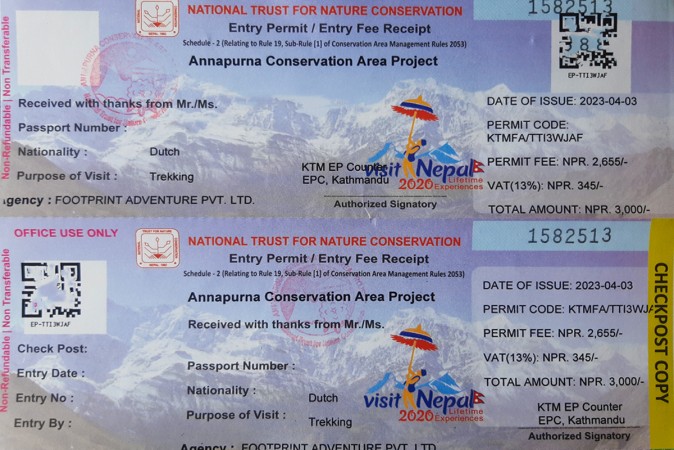
Two permits are mandatory for the Annapurna Base Camp Trek:
Together, mandatory permit costs for the ABC Trek run about NPR 4,000–5,000 (USD 30–40) per person. No restricted-area permit is needed for the standard Annapurna Base Camp route, unlike treks into Upper Mustang or Manaslu. Fees are periodically revised, so confirm current rates with the Nepal Tourism Board or your trekking company before your trip.
💡 Guide note: Permit fees are set by the Nepal government and can change. Always confirm current rates before you travel.
Kathmandu to Pokhara: A tourist bus costs roughly USD 10–20 one-way; a domestic flight (about 25 minutes) costs roughly USD 100–150 one-way, though fares fluctuate with season and airline. The flight saves 6–7 hours of driving and is worth considering if your schedule is tight.
Pokhara to the trek starting point (Nayapul, Kimche, or Ghandruk) and back: A shared jeep or local bus costs around NPR 400–800 (USD 3–6) per person each way; a private jeep for a small group runs NPR 3,500–6,000 (USD 25–45) total, split among passengers.
💡 Guide note: Return transportation mirrors the outbound cost. Budget travelers save by using public buses throughout; mid-range and premium packages typically include private vehicles for at least the Pokhara–trailhead legs.
Teahouse (lodge) accommodation on the Annapurna Base Camp route is simple: twin-share rooms with shared bathrooms at lower elevations, and more basic facilities as you climb. Prices run NPR 300–800 (USD 2–6) per night at lower villages like Ghandruk or Chhomrong, rising to NPR 500–1,500 (USD 4–11) per night near Deurali, Machhapuchhre Base Camp, and Annapurna Base Camp itself, where everything must be carried in by porters or mules. Many teahouses discount the room rate heavily (sometimes to nearly free) if you eat your meals there — which is the local norm and the best way to keep costs down.
Food is one of the biggest variables in your Annapurna Base Camp Trek budget, and prices rise steadily with altitude because everything is carried up by porter or mule train. Typical prices:
| Item | Lower Villages (Ghandruk–Chhomrong) | Near ABC/MBC |
|---|---|---|
| Dal bhat (rice, lentils, vegetables, refills) | NPR 400–600 | NPR 800–1,200 |
| Noodles / soup | NPR 300–450 | NPR 500–700 |
| Momos | NPR 350–500 | NPR 600–800 |
| Breakfast (eggs, toast, porridge, pancake) | NPR 250–400 | NPR 400–600 |
| Tea / coffee | NPR 100–200 | NPR 200–350 |
| Bottled/mineral water (1L) | NPR 100–200 | NPR 250–400 |
Most trekkers spend USD 25–35 per day on food, or a bit more if they order Western dishes and multiple hot drinks.
Insider Tip: Carrying a reusable bottle with purification tablets or a filter is one of the easiest ways to cut costs at altitude, where bottled water gets expensive.
A licensed, government-registered trekking guide typically costs USD 25–35 per day.
Beyond navigation, a good local guide handles teahouse negotiations, monitors for altitude sickness symptoms, communicates with rescue services if needed, and adds cultural context to villages along the route. For first-time trekkers unfamiliar with high-altitude trails, this is widely considered one of the most valuable costs on the trip, not just a formality.
Porters typically cost USD 20–25 per day and are usually shared between two trekkers, each porter carrying a combined load of around 15–20 kg (roughly 10 kg per client, kept within ethical, regulated weight limits). Hiring a porter reduces physical strain significantly on a multi-day trek and directly supports local employment in the region.
Most trekkers arrive with hiking boots and a daypack already, then rent or buy the rest in Kathmandu or Pokhara:
💡 Insider Tip: Renting rather than buying is common for one-time trekkers and keeps upfront costs low.
Travel insurance that covers high-altitude trekking (ideally up to 6,000m) and emergency evacuation is essential, not optional. A suitable policy for a 1–2 week Nepal trip typically costs USD 100–150. Skimping here is one of the few places on this trek where a lower price genuinely increases your risk — a helicopter evacuation from high altitude without insurance can cost thousands of dollars out of pocket.
Budget for the following extras, which add up over a trip:
Here's a practical sample budget for a solo mid-range trekker starting and ending in Kathmandu, on a 10-day itinerary (Kathmandu → Pokhara → trek start → ABC → Pokhara → Kathmandu):
| Expense | Approximate Cost |
|---|---|
| Kathmandu–Pokhara–Kathmandu (tourist bus, round trip) | USD 25–35 |
| Pokhara–trailhead–Pokhara transportation | USD 20–40 |
| ACAP + TIMS permits | USD 30–40 |
| Guide (8 days on trail) | USD 200–280 |
| Porter (8 days on trail, shared) | USD 90–130 |
| Accommodation (8 nights) | USD 25–70 |
| Food (8 days) | USD 200–280 |
| Tips and miscellaneous | USD 60–100 |
| Approximate total | USD 650–975 |
This excludes international flights to Nepal, the Nepal tourist visa fee, Kathmandu hotel nights before/after the trek, and personal shopping.
| Factor | Independent Trekking | Organized Trekking Package |
|---|---|---|
| Planning | You arrange everything yourself | Handled by the trekking company |
| Permits | You queue and pay separately | Included and pre-arranged |
| Transportation | You book each leg yourself | Bundled and coordinated |
| Accommodation | You negotiate room-by-room | Pre-arranged with trusted lodges |
| Guide | Optional; extra cost if hired later | Included |
| Porter | Optional; extra cost if hired later | Included |
| Safety support | Depends on your own judgment | Guide monitors altitude symptoms |
| Communication | Limited if you don't speak Nepali | Guide bridges language gaps |
| Emergency assistance | You coordinate rescue yourself | Company coordinates on your behalf |
| Cost predictability | Variable, can spike unexpectedly | Mostly fixed upfront |
Independent trekking can be cheaper on paper and works well for experienced, self-sufficient hikers who are comfortable navigating logistics in a foreign country. But an organized package often provides better overall cost predictability and peace of mind, especially for first-time trekkers, solo travelers, or anyone trekking during peak season when teahouse space can be tight.
Trekkers often forget to budget for: hot showers, device charging, Wi-Fi, snacks and extra drinks, tips for guide and porter, gear rental, travel insurance, emergency transportation (helicopter evacuation if needed), an extra night's accommodation in Pokhara or Kathmandu if your flight or the trek itself is delayed, and additional trekking days caused by weather. Keeping a personal emergency buffer of USD 100–150 on top of your planned budget is a sensible habit for any Himalayan trek.
Spring (March–May) and autumn (September–November) are the most popular seasons and best time for the Annapurna Base Camp Trek , with the clearest mountain views and best trail conditions — but also the highest demand for teahouse rooms and guides, which can mean less room to negotiate prices.
Monsoon (June–August) brings rain, leeches, and cloud cover, but also lower demand and sometimes better availability. Winter (December–February) is colder and quieter, with excellent visibility on clear days but a higher chance of snow closing the higher sections of the trail temporarily, which can add unplanned days (and cost) to your trip.
Most Annapurna Base Camp itineraries run 7 to 12 days on the trail, depending on whether you include the Ghorepani–Poon Hill detour, extra acclimatization days, or a hot spring stop at Jhinu Danda. A longer itinerary means more nights of accommodation, more days of food, more guide and porter days, and more logistics — all of which add to the total cost. Shorter itineraries save money but leave less buffer for weather delays or altitude adjustment. See our full Annapurna Base Camp Trek itinerary for a day-by-day breakdown.
| Factor | Annapurna Base Camp Trek | Annapurna Circuit Trek |
|---|---|---|
| Duration | 7–12 days | 12–18 days |
| Distance | Shorter, out-and-back style route | Longer, full circuit around the Annapurna massif |
| Accommodation | Teahouses throughout | Teahouses throughout |
| Transportation | Kathmandu–Pokhara–trailhead | Kathmandu–Besisahar or similar, longer approach |
| Permits | ACAP + TIMS | ACAP + TIMS |
| Guide/porter | Recommended | Recommended, especially for the high pass |
| Typical overall budget | USD 700–1,100 | USD 900–1,500+ |
| Experience | Sanctuary views, closer to the peaks | Greater variety of landscapes and Thorong La pass crossing |
Because it's shorter, the Annapurna Base Camp Trek is usually the more budget-friendly option of the two. If you're weighing both, see our detailed Annapurna Circuit Trek guide for a full comparison.
A well-organized Annapurna Base Camp Trek package with Orbit Nepal Adventure typically covers the core logistics that are hardest to arrange on your own: airport arrival assistance, ground transportation between Kathmandu, Pokhara, and the trailhead, teahouse accommodation during the trek, meals on the trail, a licensed trekking guide, porter service, all required dpermits (ACAP and TIMS), trekking company service charges, staff insurance, and applicable government taxes, along with emergency support if something goes wrong on the trail.
If you prefer a well-organized trek with the major logistics handled for you, booking a complete Annapurna Base Camp Trek Package with Orbit Nepal Adventure can make planning much easier — you show up with your gear, and the guide, porter, permits, and accommodation are already arranged.
➤ Most guided packages cost between USD 700 and USD 1,600 per person, depending on trek duration, group size, and service level. Independent budget trekking can run as low as USD 300–450 for the on-trail portion alone.
➤ Including transportation, permits, guide, porter, food, and accommodation for a 9–10 day trip starting and ending in Kathmandu, expect roughly USD 650–975 for a mid-range guided trek.
➤ Compared to many international trekking destinations, it's relatively affordable. A guided, all-inclusive trek is a mid-range travel expense, and independent trekking can be done on a tighter backpacker budget.
➤ A typical Orbit Nepal Adventure package includes transportation, teahouse accommodation, meals on the trail, a licensed guide , a porter, all permits, government taxes, staff insurance, and emergency support.
➤ Beyond your prepaid package cost, carry USD 150–250 in cash (or NPR equivalent) for tips, drinks, snacks, Wi-Fi, charging, and a personal emergency buffer.
➤ It isn't always legally mandatory for this specific route, but a licensed guide adds real safety value, especially for first-time Himalayan trekkers, and is included in most organized packages.
➤ Expect around NPR 4,000–5,000 (USD 30–40) total for ACAP and TIMS combined, for foreign nationals.
➤ Roughly USD 25–35 per day, rising toward the upper end of that range or slightly beyond at higher elevations near Annapurna Base Camp itself.
➤ Trek independently without a guide or porter, use public buses, stay in the most basic teahouses, and eat where you sleep. This can bring the on-trail cost down to roughly USD 25–35 per day.
➤ For the mountain scenery, cultural exposure to Gurung and Magar villages, and the relatively short time commitment compared to longer Himalayan treks, most trekkers find it well worth the investment.
➤ October and April are generally considered the best months, offering the clearest mountain views and most stable weather, though both are also peak season for cost and crowding.
➤ Yes. Independent trekking, off-peak timing, group travel, and careful food/drink choices can bring your total trip cost down significantly compared to a premium package.
Ready to walk into the heart of the Annapurna Sanctuary?Contact Orbit Nepal Adventure today for customized itineraries for easier and adventurous trek.
📲 Contact us directly on WhatsApp: Chat with us on WhatsApp
🌐 Visit: orbitnepaladv.com
📧 Email: orbitnepaladv@gmail.com
💬 Whatshapp: 977-9841766021
Our Package : Annapurna Base Camp