Thamel, Kathmandu, Nepal
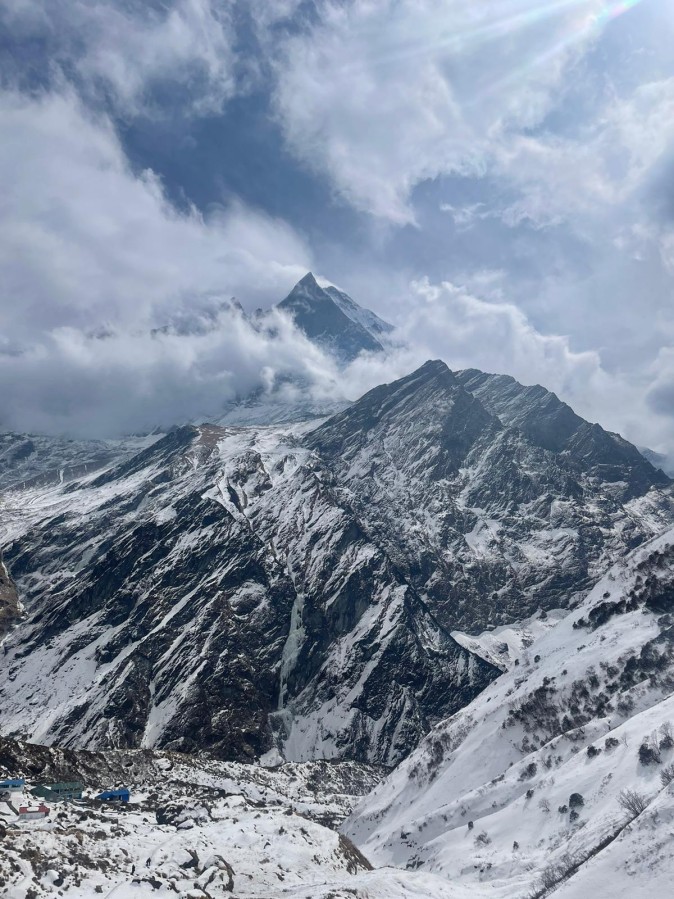
Two of Nepal's most-loved treks share the same mountain range, the same conservation area, and almost the same starting point near Pokhara — yet they deliver completely different experiences. The Annapurna Base Camp Trek (ABC) is a shorter, concentrated journey into a natural amphitheater of 7,000m and 8,000m peaks. The Annapurna Circuit Trek (ACT) is a longer, more varied journey that circles the entire Annapurna massif, crossing one of the highest trekking passes on earth along the way.
If you're trying to decide between them, the honest answer is: it depends on your time, your fitness, your appetite for altitude, and what kind of story you want to tell when you get home.
🏔️ Quick take: Choose ABC for a shorter trip (7–12 days) with concentrated, close-up mountain views. Choose the Circuit for a longer journey (12–18 days) with greater landscape diversity and a high-altitude pass crossing.
At Orbit Nepal Adventure, we run both treks regularly, and this comparison draws on what we actually see on the trail, not just brochure descriptions.
| Feature | Annapurna Base Camp | Annapurna Circuit |
|---|---|---|
| Typical duration | 7–12 days | 12–18 days (shorter with road/jeep sections) |
| Difficulty | Moderate | Moderate to strenuous |
| Highest point | 4,130m (Annapurna Base Camp) | 5,416m (Thorong La Pass) |
| Trek style | Out-and-back into the Annapurna Sanctuary | Circuit around the Annapurna massif |
| Major highlights | Annapurna Sanctuary, Machhapuchhre Base Camp, Poon Hill (optional), Jhinu hot springs | Manang, Thorong La, Muktinath, Kali Gandaki Gorge, Mustang landscapes |
| Mountain views | Close-up, concentrated amphitheater | Broad, constantly changing panoramas |
| Cultural experience | Gurung and Magar villages | Gurung, Manangi, Thakali villages; Tibetan-influenced monasteries |
| Landscape variety | Subtropical forest to high alpine | Subtropical forest to high desert — most varied trek in Nepal |
| Beginner suitability | Good, with a sensible pace | Moderate — doable for fit beginners, but altitude demands respect |
| Physical demand | Moderate-high (steep stone stairs) | High (long pass-crossing day, sustained altitude) |
| Approximate cost | Generally lower (shorter duration) | Generally higher (more trekking days) |
| Best for | First-timers, shorter trips, max mountain drama per day | Experienced/ambitious trekkers wanting variety and altitude challenge |
Note: Exact durations, costs, and difficulty ratings vary by itinerary, season, and trekking pace — figures above reflect typical Orbit Nepal Adventure departures.
ABC starts in the mid-hills near Nayapul or Ghandruk and climbs steadily through rhododendron and bamboo forest before entering the Annapurna Sanctuary — a glacial basin ringed almost completely by mountains. The trail passes through Gurung and Magar villages like Ghandruk, Chhomrong, and Sinuwa, where stone houses, prayer flags, and terraced fields give the route a strong sense of place even before the high mountains appear.
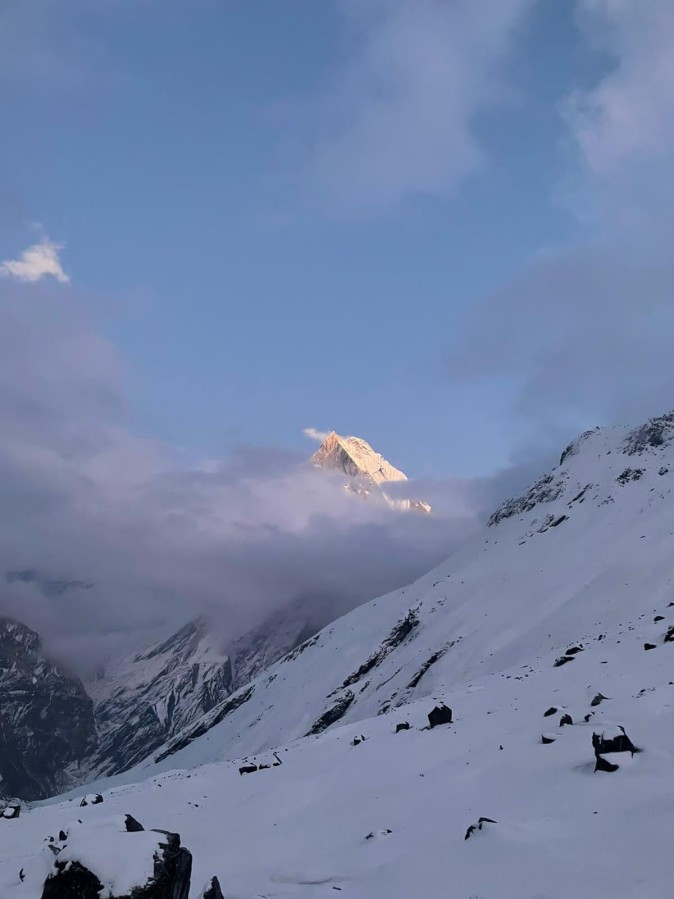
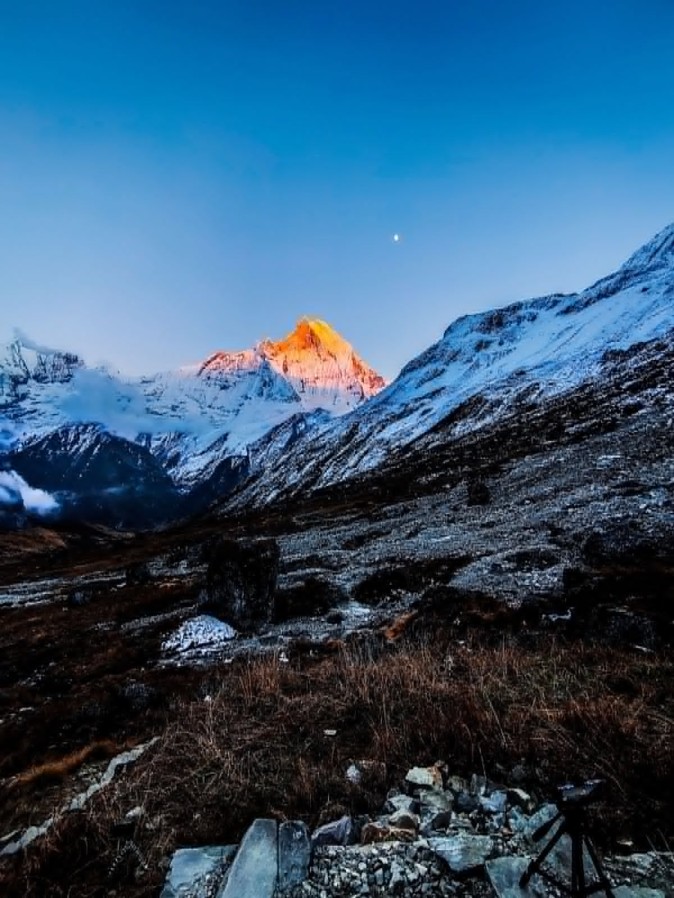
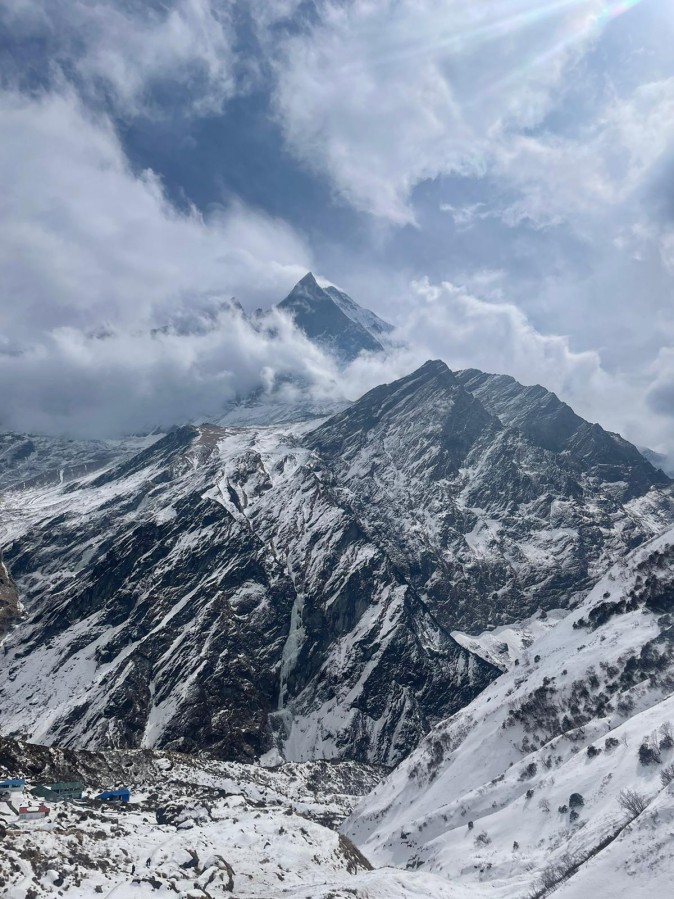
The last two days are the payoff: from Deurali, the trail narrows into the Modi Khola gorge and opens suddenly at Machhapuchhre Base Camp (3,700m), where the fishtail summit of Machhapuchhre fills the sky. An hour or two further, at 4,130m, you reach Annapurna Base Camp itself, encircled by Annapurna I (8,091m), Annapurna South (7,219m), and Hiunchuli (6,441m). Most trekkers spend one night at ABC to watch both sunset and sunrise light up the peaks before descending.
Daily walking distances run roughly 5–15km, and while the altitude gain is gentler than on the Circuit, the terrain isn't — the stone staircases around Chhomrong and Ulleri are notoriously steep in both directions. If you want the full breakdown of where you'll sleep each night and how the days are paced, our detailed Annapurna Base Camp Trek itinerary covers the day-by-day route, including optional rest days and the popular Poon Hill sunrise extension.
The Circuit begins in the lush, terraced Marsyangdi Valley and climbs gradually through a changing sequence of environments: subtropical villages near Besisahar and Bhulbhule, pine and fir forest around Chame, and increasingly stark, high-altitude terrain as you approach Manang (3,540m) — a Tibetan-influenced town where flat-roofed houses, prayer wheels, and centuries-old gompas reflect centuries of trans-Himalayan trade with Tibet.
From Manang, most itineraries build in an acclimatization day, often with a side hike to Ice Lake or the Gangapurna viewpoint, before pushing on to Thorong Phedi or High Camp ahead of the pass crossing. Thorong La (5,416m) is the trek's defining day: a pre-dawn start, several hours of steady climbing in bitter cold, and a long descent of nearly 1,600m to Muktinath, a pilgrimage town sacred to both Hindus and Buddhists.
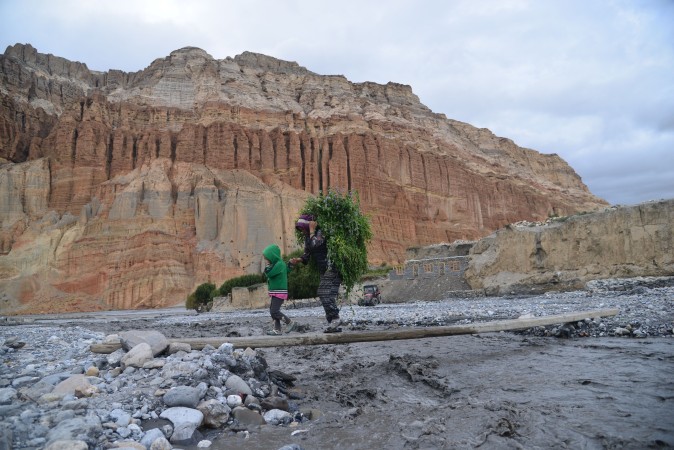
Beyond Muktinath, the trail drops into the dramatic, wind-scoured Kali Gandaki Gorge — one of the deepest gorges on earth — passing through Jomsom, Marpha (famous for apple orchards and local brandy), and on toward Tatopani's natural hot springs, or exiting by road/flight from Jomsom for a shorter itinerary. Trekkers drawn to this side of the Annapurna region often extend further into Upper Mustang, a restricted-area trek with its own permit requirements and rain-shadow climate. For the full day-by-day route, elevation profile, and side-trip options, see our complete Annapurna Circuit Trek itinerary.
ABC typically takes 7–12 days round-trip from Pokhara, depending on your starting trailhead and whether you add Poon Hill.
The Circuit runs longer — usually 12–18 days for the full route, though jeep access as far as Chame or Manang has let some itineraries compress the lower sections without cutting the high-altitude core.
ABC is physically demanding in a specific way: long stretches of stone stairs that hammer your knees and thighs, especially descending from Chhomrong. But because the trek tops out at 4,130m, altitude-related difficulty stays moderate for most trekkers who ascend at a sensible pace.
The Circuit is demanding in a broader way — sustained days at 3,500m+ for over a week, plus the single hardest day of either trek: the Thorong La crossing, which combines extreme cold, thin air, and 7–8 hours of continuous walking.
ABC's high point is 4,130m.
The Circuit's high point, Thorong La, is 5,416m — over 1,200m higher, and firmly in the range where altitude sickness becomes a serious consideration for every trekker, not just the unlucky few.
ABC's reward is concentration: after days of forest walking, the Sanctuary opens into an almost 360-degree wall of 6,000–8,000m peaks, all visible from one relatively compact area.
The Circuit's reward is range: terraced farmland, pine forest, high alpine desert, and the eroded cliffs of Mustang within a single trek.
ABC passes through Gurung and Magar communities in the middle hills, with a noticeably Hindu-Buddhist blend closer to Pokhara.
The Circuit's cultural range is wider — lowland Gurung villages give way to Manangi and then Thakali communities, with strong Tibetan Buddhist influence visible in Manang's gompas and Mustang's chörtens.
Because it circles the range rather than heading straight into it, the Circuit generally offers the greater landscape diversity — moving from subtropical river valleys to alpine terrain to genuine high desert in two weeks. ABC's landscape changes too, but within a narrower band, culminating in the concentrated glacial sanctuary.
ABC feels like a pilgrimage toward one dramatic destination — the anticipation builds as the sanctuary walls close in.
The Circuit feels more like a journey through several distinct worlds, with the pass crossing as its central turning point rather than its final destination.
There's no universal answer — "beginner-friendly" depends on your baseline fitness, prior high-altitude experience, available time, and how well your itinerary is paced.
However, ABC is generally the more forgiving introduction to Himalayan trekking: shorter duration, lower maximum altitude, and a trail that stays busy enough that help and teahouses are never far away.
The Circuit isn't off-limits for beginners, but it asks more of you ; a longer physical commitment and a genuine test at altitude on pass day. A fit beginner with no prior altitude exposure can absolutely complete the Circuit, provided the itinerary includes proper acclimatization days.
Choose ABC if you want:
Choose the Circuit if you want:
Note: This comes down to what kind of view and experience you want, not which trek "wins."
Both treks share the same two prime seasons: spring (March–May) and autumn (late September–November).
Note: For a full month-by-month breakdown, see our Best Time for Annapurna Base Camp Trek guide.
As a general range, expect 7–12 days for ABC and 12–18 days for the Circuit.
Our detailed Annapurna Base Camp Trek itinerary and Annapurna Circuit Trek itinerary break down exactly where you'll sleep each night, how much elevation you'll gain, and where the built-in rest days fall.
Cost on both treks is driven by the same major factors: transportation to and from the trailhead, teahouse accommodation and food, guide and porter fees, permits, travel insurance, and personal gear.
Because the Circuit runs longer ; accumulate over more days and food prices climb further once you're above Manang and again in drier Mustang - the Circuit is more expensive than ABC in general.
Rather than quote fixed figures that shift with season and operator, our Annapurna Base Camp Trek Cost guide breaks down budget, mid-range, and premium tiers with a direct Circuit comparison.
Both treks fall within the Annapurna Conservation Area, so both require the ACAP (Annapurna Conservation Area Permit) and the TIMS card.
Since April 2023, independent trekking without a licensed guide has been restricted on both routes, and TIMS cards must now be issued through a registered trekking agency.
Trekkers continuing into Upper Mustang will also need the separate Restricted Area Permit.
Note: For the full fee breakdown, see our Permits Required for Annapurna Base Camp Trek guide.
The core packing list overlaps heavily: sturdy trekking boots, moisture-wicking base layers, a warm insulated jacket, a waterproof shell, trekking poles, a headlamp, a water bottle, sun protection, a basic first-aid kit, and your permits and passoports in a waterproof pouch.
Where the two treks diverge is the margin for error at altitude. ABC's lower elevation means a 3-season sleeping bag is usually sufficient. The Circuit's Thorong La crossing regularly sees sub-freezing pre-dawn temperatures, so Circuit trekkers need a sleeping bag rated to at least -15°C to -20°C, sturdier gloves and headwear, and gaiters in early/late season.
Note: See our full Annapurna Trek Packing List for the complete breakdown.
Altitude sickness (AMS) can affect any trekker regardless of fitness level, and it's a bigger factor on the Circuit given the higher maximum elevation.
The core principles are the same on both treks: ascend gradually, build in scheduled acclimatization days (Chhomrong/Bamboo on ABC; Manang on the Circuit), stay hydrated, avoid alcohol at altitude, and watch for symptoms like persistent headache, nausea, or unusual fatigue.
Note: Descending is always the right call if symptoms worsen.
Choose Annapurna Base Camp if you:
Choose Annapurna Circuit if you:
| If you want... | Choose |
|---|---|
| A shorter trek | Annapurna Base Camp |
| A longer, more immersive adventure | Annapurna Circuit |
| The Annapurna Sanctuary experience | Annapurna Base Camp |
| To cross Thorong La Pass | Annapurna Circuit |
| Greater landscape diversity | Annapurna Circuit |
| Concentrated, close-up mountain views | Annapurna Base Camp |
| More time for cultural exploration | Annapurna Circuit |
| A trek that fits a limited vacation window | Annapurna Base Camp |
➤ Generally, yes — ABC has a lower maximum altitude (4,130m vs. 5,416m) and a shorter duration, which reduces both the physical and altitude-related demands compared to the Circuit's pass crossing.
➤ Neither is objectively better — ABC suits travelers who want a shorter, concentrated mountain experience, while the Circuit suits those who want a longer journey with greater landscape and cultural variety.
➤ ABC is generally the more approachable option for first-time Himalayan trekkers, thanks to its shorter length and lower maximum altitude, though fit beginners with a well-paced itinerary can also complete the Circuit.
➤ The Circuit takes longer, typically 12–18 days compared to ABC's 7–12 days, depending on the specific itinerary and any side trips.
➤ ABC offers a concentrated, close-up amphitheater of peaks, while the Circuit offers broader, more varied panoramas across several distinct landscapes — it depends on which style of view you prefer.
➤ Yes, overall — the Circuit's higher maximum altitude, longer duration, and demanding Thorong La crossing make it more physically and logistically challenging than ABC.
➤ Annapurna Base Camp itself sits at approximately 4,130m.
➤ Thorong La Pass, at approximately 5,416m, is the highest point on the Circuit.
➤ October and November (autumn) and March through May (spring) are the most reliable months for both treks, offering clear skies and stable trail conditions.
➤ Yes , since April 2023, independent trekking without a licensed guide is restricted on Nepal's major routes, including both ABC and the Circuit, and TIMS cards must be issued through a registered trekking agency.
➤ Both treks require the ACAP (Annapurna Conservation Area Permit) and a TIMS card; trekkers extending into Upper Mustang from the Circuit also need a separate Restricted Area Permit.
➤ Costs vary by season, service level, and itinerary length, but the Circuit generally costs more than ABC due to its additional trekking days and higher-altitude logistics — see our detailed cost guide for a full breakdown.
There's no wrong choice between these two treks — only the right one for the time, fitness level, and travel goals you're bringing to Nepal right now. If a week of walking toward a dramatic, enclosed wall of 7,000m and 8,000m peaks appeals to you, Annapurna Base Camp delivers that experience efficiently and reliably. If you have closer to three weeks and want a longer journey that moves through forest, alpine terrain, and high desert while crossing a genuine Himalayan pass, the Annapurna Circuit is the more complete adventure.
Ready to walk into the heart of the Annapurna Sanctuary?Contact Orbit Nepal Adventure today for customized itineraries for easier and adventurous trek.
📲 Contact us directly on WhatsApp: Chat with us on WhatsApp
🌐 Visit: orbitnepaladv.com
📧 Email: orbitnepaladv@gmail.com
💬 Whatshapp: 977-9841766021
Our Package : Annapurna Base Camp